


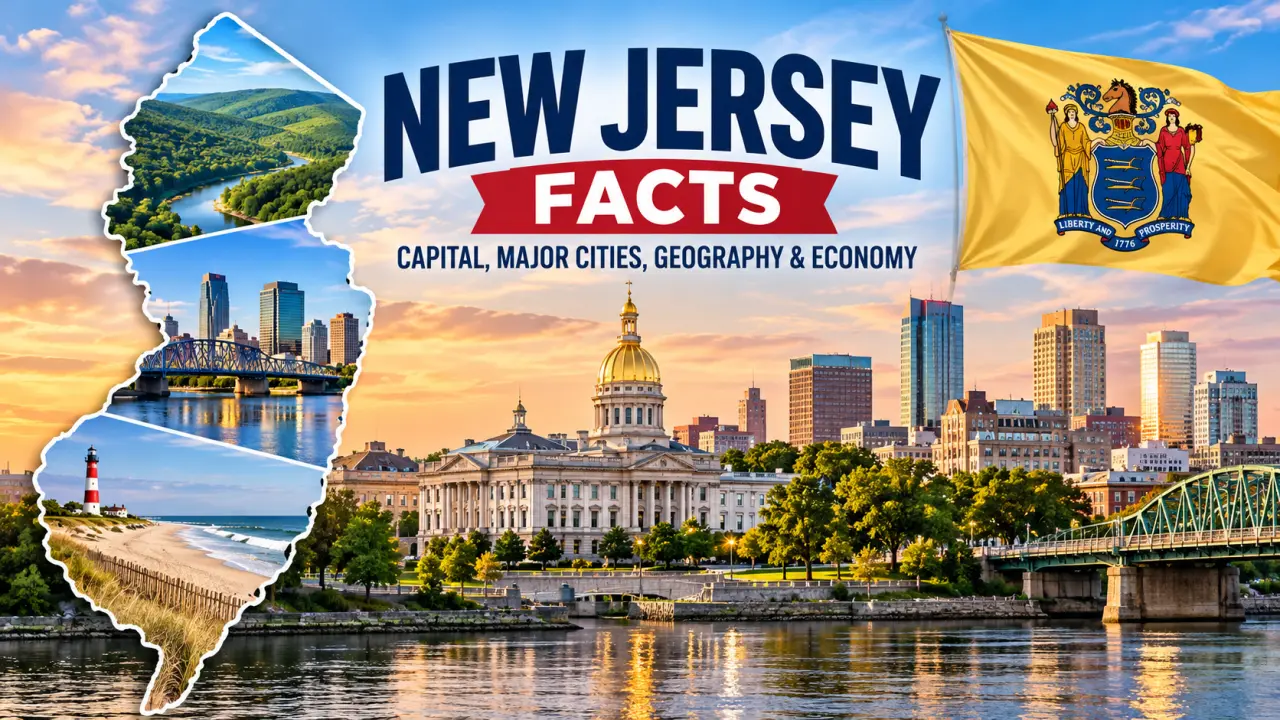
New Jersey Facts: Capital, Major Cities, Geography & Economy
New Jersey is a northeastern U.S. state where crowded metropolitan corridors sit surprisingly close to mountain forests, farmland, wetlands, and Atlantic beaches. Trenton is its capital, Newark is its largest city, and the Garden State was the third state to ratify the U.S. Constitution on December 18, 1787. Its location between New York City and Philadelphia has shaped its history, population, transportation networks, and economy.
The U.S. Census Bureau estimated 9,548,215 residents on July 1, 2025. New Jersey also generated approximately $887.8 billion in current-dollar gross domestic product (GDP) in calendar year 2025, according to revised federal economic data released in September 2026. These figures describe different measurements and should always be read with their reference periods. This guide explains the facts, the reasons behind them, and the ideas students can use in geography, history, economics, and general-knowledge quizzes.
New Jersey Quick Facts
| Fact | New Jersey information |
|---|---|
| Official name | State of New Jersey |
| Postal abbreviation | NJ |
| Nickname | The Garden State |
| Capital | Trenton |
| Largest incorporated city | Newark |
| U.S. Census region | Northeast; Middle Atlantic division |
| Constitutional ratification / customary statehood date | December 18, 1787 (3rd state) |
| Total area | About 8,723 square miles (state government geographic summary) |
| Land area | 7,354.76 square miles (2020 Census) |
| Population | 9,548,215 (July 1, 2025 Census estimate) |
| Population density | 1,263.0 people per square mile (2020 Census) |
| Counties | 21 |
| Municipalities | 564 |
| Highest point | High Point, 1,803 feet |
| Major rivers | Delaware, Hudson, Passaic, Raritan |
| Atlantic shore | About 126 miles of oceanfront, Sandy Hook to Cape May |
| Time zone | Eastern Time |
| Traditional motto | Liberty and Prosperity (not separately officially adopted) |
| State bird | Eastern goldfinch |
| State flower | Violet |
| State tree | Red oak |
| State animal | Horse |
| State fruit | Blueberry |
Data note: The state estimates and 2020 Census measurements above are intentionally labeled by year. Area summaries from the state government are rounded. Sources include the Census Bureau, NJ.gov Fast Facts, and NJ.gov facts FAQ.
Where Is New Jersey Located?
New Jersey is in the northeastern United States, on the Atlantic coast. The Census Bureau places it in the Northeast region and Middle Atlantic division. Its southern and central landscapes face the Atlantic Ocean and Delaware Bay, while the northeastern part of the state forms part of the New York metropolitan area. The southwest is closely connected to Philadelphia.
What States Border New Jersey?
New Jersey shares boundaries with New York, Pennsylvania, and Delaware. New York lies to its north and northeast. The Delaware River separates New Jersey from much of eastern Pennsylvania. Delaware lies across parts of the Delaware River and Delaware Bay; because of unusual colonial boundary rules, short land boundaries also exist where Delaware territory meets land physically connected to New Jersey.
The distinction matters: most state maps make the western boundary look like a straightforward river line, but the Delaware-New Jersey boundary is not always the river midpoint. For a wider regional comparison, see New York State facts, Pennsylvania facts, and Delaware facts.
How Large Is New Jersey?
The state reports roughly 8,723 square miles of total area, including approximately 1,368 square miles of water. The 2020 Census measured 7,354.76 square miles of land. New Jersey is the fourth-smallest state by total area and the fifth-smallest by land area, yet its smaller size has not prevented large urban centers and extensive transportation development. Its forests and agricultural districts are also substantial.
Geography of New Jersey
New Jersey’s terrain changes markedly over a short distance. Ridges and valleys dominate the northwest; rocky uplands and rolling hills appear farther east; low, sandy land extends across much of the south and toward the ocean. These differences affect soils, farming, settlement, river systems, and the location of transportation routes.
Four Main Physical Regions
| Region | Where it lies | Landscape and significance |
|---|---|---|
| Valley and Ridge | Far northwest | Appalachian ridges and long valleys, including Kittatinny Ridge; forests and hiking areas |
| Highlands (New England physiographic province) | Northwest and north-central interior | Rocky uplands, reservoirs, forested watersheds, and communities separated by hills |
| Piedmont | North-central belt | Rolling hills and river valleys with dense residential and industrial development |
| Atlantic Coastal Plain | South and east | Lower terrain, sandy and gravelly deposits, forests, farms, wetlands, and coastal beaches |
The U.S. Geological Survey describes these as the state’s four major physiographic divisions. Some geological reports call the Highlands the New England province. The two names refer to the same broad part of this regional classification, not to an additional fifth region.
Mountains, High Point, and the Highlands
High Point, at 1,803 feet above sea level, is New Jersey’s highest natural point. It stands on Kittatinny Ridge in Sussex County. The ridge belongs to the Appalachian system. High Point State Park and nearby protected lands contain forests, lakes, and viewpoints. The Highlands farther east are also important because their watersheds and reservoirs help supply drinking water to communities in northern New Jersey.
Rivers, Lakes, and Waterways
Four rivers illustrate the importance of water in New Jersey. The Delaware River shaped colonial trade and still forms a major western boundary. The Hudson River connects Jersey City and Hoboken to the New York Harbor region. The Passaic River includes Paterson’s Great Falls, whose waterpower encouraged industrial development. The Raritan River drains part of central New Jersey toward Raritan Bay. Lake Hopatcong is another important northern New Jersey freshwater and recreation resource.
Jersey Shore, Wetlands, and the Pine Barrens
The Jersey Shore extends along New Jersey’s Atlantic oceanfront from Sandy Hook to Cape May. Its beaches, barrier islands, tidal bays, and resort communities support tourism and recreation. Coastal wetlands also provide wildlife habitat and help absorb some wave and flood impacts. However, development in low-lying areas faces risks from coastal storms, erosion, and sea-level rise.
Farther inland, the Pinelands National Reserve includes approximately 1.1 million acres of pine and oak forests, wetlands, farms, and communities. Established in 1978, it covers about 22% of New Jersey’s land area and protects habitats and groundwater resources, including the Kirkwood-Cohansey aquifer. It is a reminder that New Jersey’s reputation for density describes its population, not every acre of its land.
Climate and Natural Hazards
New Jersey has four seasons. Summers are often warm and humid, while winters can bring freezing temperatures and snow, especially inland and at higher elevations. The Atlantic Ocean moderates some coastal temperatures, but the shore is exposed to nor’easters, storm surge, and tropical weather systems. Heavy rainfall can also cause river or urban flooding. The New Jersey Department of Environmental Protection monitors climate change and rising coastal water levels; long-term projections should not be confused with one particular year’s weather.
What Is the Capital of New Jersey?
Trenton is the capital of New Jersey. It is in Mercer County on the Delaware River, opposite Pennsylvania. The city houses the State House and other government institutions. Newark, which has more residents, is the largest city rather than the capital.
Why Did Trenton Become the Capital?
Colonial New Jersey had previously used Burlington and Perth Amboy as seats of government in West and East Jersey. After independence, Trenton’s relatively central location and access to major travel routes made it a practical place for state officials to meet. It became the state capital in 1790. The New Jersey State House, completed in 1792, remains in use.
Trenton in American History
The city is remembered for George Washington’s victory over Hessian forces on December 26, 1776, following the crossing of the Delaware River. Places such as the Old Barracks, Trenton Battle Monument, and State House help explain Trenton’s civic and Revolutionary War heritage. Students should keep the dates separate: the Battle of Trenton was in 1776; Trenton became capital in 1790.
Major Cities in New Jersey
New Jersey’s cities serve different purposes: Newark is a commercial and transportation center, Jersey City is closely connected to Manhattan, Paterson preserves an industrial past, and Trenton is the government capital. City populations below are July 1, 2025 Census Bureau estimates, not metropolitan-area counts.
| Incorporated city | 2025 population estimate | Why it matters |
|---|---|---|
| Newark | 323,808 | Largest city; airport, education, business, and transportation |
| Jersey City | 302,013 | Hudson waterfront, finance, offices, and transit to Manhattan |
| Paterson | 161,793 | Manufacturing history and Great Falls |
| Elizabeth | 141,675 | Port and airport-related logistics, industry, and commerce |
| Trenton | 91,506 | Capital and Revolutionary War history |
| Clifton | 91,127 | Major residential and business community in Passaic County |
| Camden | 71,430 | Delaware River city, education, health care, and industrial heritage |
Population scope: This is a selected table of incorporated cities. New Jersey also has populous townships such as Lakewood, Edison, Woodbridge, and Toms River. A ranking of every municipality differs from a ranking of places legally designated as cities. Figures come from the Census Bureau’s Vintage 2025 city and town estimates.
Newark and Jersey City
Newark’s access to Newark Liberty International Airport, rail terminals, and the Port Newark-Elizabeth area supports its long role in transportation and trade. It also houses Rutgers University-Newark and the New Jersey Institute of Technology. Jersey City sits across the Hudson River from Manhattan and has major transit links, waterfront housing, offices, and financial services. Its economy reflects the shared labor and business market of northern New Jersey and New York City.
Paterson, Elizabeth, Camden, and Other Centers
Paterson grew around water-powered factories at the Great Falls; textiles, silk, and machinery became part of its identity. Elizabeth’s location near Newark airport and port facilities supports trade and distribution. Camden faces Philadelphia across the Delaware River and has a mix of health care, educational institutions, and historic industry. Atlantic City is known for beaches, its boardwalk, and entertainment; Hoboken for its Hudson waterfront and commuter links; Princeton for its university and research activity. A city’s importance does not depend on population alone.
Population of New Jersey
Population Growth and Estimates
The U.S. Census Bureau estimated 9,548,215 residents on July 1, 2025. In the same Vintage 2025 series, the April 1, 2020 estimates base is 9,289,024, giving about 2.8% growth to July 2025. Unlike the annual estimate, a decennial Census figure is a count taken at a specified date.
| Reference date | Population | Type |
|---|---|---|
| April 1, 2010 | 8,791,894 | Decennial Census count |
| April 1, 2020 | 9,288,994 | Decennial Census count |
| July 1, 2025 | 9,548,215 | Vintage 2025 estimate |
The 2020 Census count and the 2020 estimates base differ slightly because the Census Bureau makes technical adjustments. For a calculated growth rate, figures should come from a consistent statistical series. New Jersey’s July 2025 estimate placed it 11th by state population.
Population Density and Settlement Patterns
The 2020 Census measured 1,263.0 residents per square mile, the highest density of any of the 50 states. That figure is specifically for 2020; it should not be labeled a 2025 density. Population is concentrated in major cities and suburban corridors near New York City, Philadelphia, and key highways. Northwestern mountain communities and parts of the southern Pinelands are much less crowded.
Diversity and Languages
New Jersey has communities with family roots across the world. The Census Bureau’s 2020-2024 American Community Survey estimates found that 23.9% of residents were foreign-born and 33.1% of residents ages five and older spoke a language other than English at home. These percentages refer to a multiyear survey period, not a one-day count.
Economy of New Jersey
New Jersey’s economy is shaped by its location, educated workforce, dense markets, transportation networks, and industrial history. The state helps move goods into and through the Northeast while also producing medicines, services, technology, food products, and manufactured materials. Agriculture and tourism remain important even though they employ fewer people than some broad service sectors.
| Industry or activity | New Jersey examples | Why it matters |
|---|---|---|
| Pharmaceuticals and life sciences | Drug research, biotechnology, medical technology | High-value research, production, and specialized jobs |
| Transportation and logistics | Port Newark-Elizabeth, airports, trucking, warehouses | Connects businesses with large regional markets |
| Health care | Hospitals, outpatient clinics, laboratories | Care provision and substantial employment |
| Finance and professional services | Insurance, accounting, consulting, financial offices | Business services for Northeast markets |
| Manufacturing | Chemicals, pharmaceuticals, food, advanced materials | Industrial output and skilled employment |
| Tourism | Jersey Shore, Atlantic City, historic sites | Seasonal and year-round hospitality activity |
| Agriculture | Blueberries, cranberries, vegetables, nursery products | Food production and protected working landscapes |
Why Transportation and Logistics Matter
Ports, highways, railroads, and Newark Liberty International Airport give New Jersey a natural advantage in distribution. The Port Newark-Elizabeth terminals are part of the Port of New York and New Jersey. Goods arriving by ship can be moved to warehouses, shops, and factories across densely populated northeastern states. This is a useful example of how a state’s geography can influence the types of jobs and businesses it develops.
Pharmaceuticals, Research, and Manufacturing
Pharmaceuticals and biotechnology are particularly associated with New Jersey. The state’s industry includes scientific research, drug development, clinical and laboratory work, and production. Universities, businesses, and health care institutions contribute to a specialized labor market. Traditional manufacturing also remains part of the economy, although factories today use technologies very different from those employed in nineteenth-century Paterson.
Farming and the Garden State Identity
New Jersey grows blueberries, cranberries, peaches, sweet corn, tomatoes, peppers, and nursery crops. The state’s Jersey Fresh program, created in 1984, promotes New Jersey-grown agricultural products. Farming continues partly because the state has fertile soils, a favorable growing season for many crops, and large nearby markets. The Garden State nickname is a reminder of this heritage, not a claim that most residents are farmers.
Tourism, Employment, and Household Income
Beaches, boardwalks, Cape May, Atlantic City, and historic parks support hotels, restaurants, entertainment, and recreation. The statewide labor market is far larger than tourism alone: the New Jersey Department of Labor reported a preliminary seasonally adjusted total of 4,377,400 nonfarm payroll jobs in September 2026 and a 4.2% unemployment rate, in a report published October 15, 2026. These figures are monthly estimates subject to revision.
For household finances, the Census Bureau reported median household income of $103,556 in its 2020-2024 survey period, expressed in 2024 dollars. This is the midpoint of household incomes and should not be interpreted as an individual worker’s wage or as GDP per capita.
GDP of New Jersey
New Jersey’s 2025 nominal GDP was approximately $887.8 billion, according to the Bureau of Economic Analysis annual GDP-by-state series revised September 30, 2026. GDP measures the value of production within the state, not the sum of residents’ salaries. Figures below use a consistent annual series.
Nominal GDP and Real GDP
| Calendar year | Current-dollar GDP | Real GDP (chained 2017 dollars) |
|---|---|---|
| 2023 | $797.9 billion | $653.9 billion |
| 2024 | $846.6 billion | $675.2 billion |
| 2025 | $887.8 billion | $688.8 billion |
Sources: BEA series distributed by the Federal Reserve Bank of St. Louis: nominal GDP (NJNGSP) and revised real GDP table (NJRGSP). Values are rounded and refer to complete calendar years. Real GDP uses chained 2017 dollars, a statistical price-adjustment measure.
Nominal GDP grew about 4.9% between 2024 and 2025, but some of that increase reflects higher prices. Using the revised real-GDP figures, inflation-adjusted output increased about 2.0%. A change in total GDP is not the same as growth in the living standard of every resident.
New Jersey GDP Per Capita
Dividing 2025 current-dollar GDP ($887.8 billion) by the July 1, 2025 population estimate gives approximately $92,980 of GDP per resident. This is a derived indicator, not an official salary estimate. It divides a full-year production total by a midyear population figure. Workers who commute across state lines, business ownership, price levels, and income distribution all limit what can be inferred about household prosperity.
Comparison With Neighboring State Economies
| State | 2025 current-dollar GDP |
|---|---|
| New York | $2.466 trillion |
| Pennsylvania | $1.056 trillion |
| New Jersey | $887.8 billion |
These figures come from the same BEA annual concept and September 2026 revision. New York and Pennsylvania have larger economies in total output; neighboring Delaware has a smaller economy, although it is not included in this numeric table because a same-revision annual figure was not confirmed for this comparison. The figures do not show which residents are wealthier. Population, land area, industry mix, cost of living, and commuter patterns matter when comparing states. The 2025 GDP totals should not be confused with a quarterly GDP figure expressed at an annual rate.
Brief History of New Jersey
The Lenape and Indigenous History
People lived in the region long before it was called New Jersey. Lenape communities maintained relationships with rivers, woods, coastal waters, farms, and trade routes. European colonization brought disease, displacement, and land loss. Indigenous peoples are not only part of the distant past: contemporary Lenape communities and descendants continue to preserve their identities, histories, and cultural traditions. Histories of European settlement should not erase them.
Colonial New Jersey
Dutch settlement grew around the Hudson, Passaic, and Raritan waterways in the seventeenth century. English control began in 1664, and the area received the name New Jersey. East Jersey and West Jersey developed separate colonial administrations before their reunification as a royal colony in 1702. Farming, commerce, and transport benefited from the colony’s position between New York and Philadelphia.
Trenton, Princeton, and Morristown in the Revolution
In late 1776, the Continental Army faced serious difficulties. On December 25-26, George Washington led troops across the Delaware River and attacked Hessian soldiers at Trenton on December 26, 1776. The victory raised morale. A second important American victory followed at Princeton on January 3, 1777. New Jersey’s roads and location made it a frequent area of military movement.
Morristown later became an important Continental Army base. During the winter of 1779-1780, troops at Jockey Hollow endured cold weather, shortages, and difficult living conditions. The location was strategically useful because mountains and surrounding terrain helped shield the army from British positions around New York City. These events are documented by the National Park Service.
Statehood, the New Jersey Plan, and Voting Rights
New Jersey adopted an independence-era state constitution in 1776. On December 18, 1787, it became the third state to ratify the proposed U.S. Constitution, after Delaware and Pennsylvania. These are different milestones: 1776 marks the creation of a state government during the independence movement; 1787 marks its place in the new federal constitutional system.
At the Constitutional Convention, William Paterson introduced the New Jersey Plan, which sought equal representation for states in the national legislature. The final Constitution combined population-based representation in the House with equal state representation in the Senate. The state’s civic history also contains exclusions and reversals: some property-owning women and free Black residents could vote under early rules, but an 1807 law restricted the franchise to white male citizens. New Jersey adopted gradual abolition legislation in 1804, yet slavery did not end immediately.
Industrialization and Modern Development
Paterson’s Great Falls helped power a planned industrial center promoted by Alexander Hamilton. Textile production, silk, machinery, chemicals, glass, and other industries developed in New Jersey, supported by water, labor, railroads, and access to Northeast markets. In the twentieth century, highways and suburban development changed settlement patterns. Universities, life-sciences research, finance, logistics, and other services subsequently became more prominent.
Government and Education
New Jersey’s government has executive, legislative, and judicial branches. Its legislature includes a 40-member Senate and an 80-member General Assembly. Local government is organized into 21 counties and 564 municipalities, including cities, boroughs, towns, townships, and villages. The distinction helps students interpret municipal population rankings.
Princeton University, Rutgers University, the New Jersey Institute of Technology, Stevens Institute of Technology, Rowan University, and Seton Hall University are among the state’s major higher-education institutions. Universities contribute through instruction, research, health sciences, engineering, and workforce preparation. Their activities help connect New Jersey’s educational system with its economy.
Famous Landmarks and Places in New Jersey
- Paterson Great Falls National Historical Park: a place where a natural waterfall and industrial history can be studied together.
- Morristown National Historical Park: Revolutionary War encampments and Washington’s headquarters.
- Princeton Battlefield: a site associated with the American victory in January 1777.
- Delaware Water Gap: a river passage through the Appalachian landscape, with protected scenery and recreation.
- High Point State Park: New Jersey’s highest natural elevation and nearby ridge landscapes.
- Liberty State Park: Jersey City waterfront views toward New York Harbor and major historic landmarks.
- Cape May: beaches, Victorian-era buildings, and coastal bird habitats.
- Atlantic City Boardwalk: a longstanding seaside resort and entertainment destination.
- New Jersey Pinelands: protected forests, wetlands, farms, and aquifers.
The best reason to study these places is not simply to memorize their names. Each helps explain a larger topic: geology, transportation, American independence, industry, ecology, or tourism.
New Jersey State Symbols
| Symbol | Designation |
|---|---|
| Nickname | Garden State |
| Traditional motto | Liberty and Prosperity (accepted usage, not separately adopted as official) |
| Bird | Eastern goldfinch |
| Flower | Violet |
| Tree | Red oak |
| Animal | Horse |
| Fruit | Blueberry |
| Fish | Brook trout |
| Bug | Honeybee |
| Reptile | Bog turtle |
| Shell | Knobbed whelk |
| Dog | Seeing Eye dog |
| Dinosaur | Hadrosaurus foulkii |
| Microbe | Streptomyces griseus |
The state government’s symbols page lists these designations. New Jersey’s buff-colored flag carries its coat of arms. Liberty stands for freedom; Ceres and the three plows refer to agriculture and abundance. The words “Liberty and Prosperity” appear on the seal. NJ.gov clarifies that this familiar motto was not separately officially adopted.
Why Is New Jersey Called the Garden State?
The nickname points to New Jersey’s agricultural heritage and its history of supplying nearby cities with produce. The exact origin of the phrase is less certain than many popular accounts suggest. The words “Garden State” were placed on license plates after a 1954 legislative effort, despite debate about whether farming uniquely defined the state. Today the nickname is familiar, even as urban and industrial activities account for much of the economy.
15 Interesting Facts About New Jersey
- New Jersey was the third state to ratify the U.S. Constitution, on December 18, 1787.
- Trenton became the capital in 1790, but Newark is now the largest incorporated city.
- The 2020 Census found New Jersey to have the highest population density among the 50 states.
- Its Atlantic oceanfront extends about 126 miles, according to the state government.
- The Pinelands National Reserve covers about 22% of New Jersey’s land area.
- High Point is the highest natural elevation in the state, at 1,803 feet.
- The victories at Trenton and Princeton came only eight days apart during the Revolutionary War.
- Morristown sheltered thousands of Continental Army soldiers during the difficult 1779-1780 winter.
- Paterson’s Great Falls supported one of the country’s earliest planned industrial centers.
- The New Jersey Plan contributed to the debate over representation at the 1787 Constitutional Convention.
- New Jersey’s most populous communities include places designated as townships, not just cities.
- New Jersey combines Atlantic beaches, suburban transportation corridors, farmland, and Appalachian ridges.
- The blueberry is the official state fruit, and the state promotes local produce through Jersey Fresh.
- New Jersey’s official state dinosaur is Hadrosaurus foulkii, associated with a Haddonfield fossil discovery.
- The phrase “Liberty and Prosperity” is accepted as the motto but was not separately adopted by statute as an official motto.
New Jersey Facts for Students: Quick Review
| Study question | Answer |
|---|---|
| Capital? | Trenton |
| Largest city? | Newark |
| Abbreviation? | NJ |
| Nickname? | Garden State |
| Statehood in customary U.S. sequence? | 3rd, December 18, 1787 |
| Counties? | 21 |
| Population? | 9,548,215 estimated on July 1, 2025 |
| Population density? | 1,263.0 per square mile in the 2020 Census |
| Highest point? | High Point, 1,803 feet |
| Western boundary river? | Delaware River |
| Major geographic regions? | Valley and Ridge, Highlands, Piedmont, Coastal Plain |
| Major industries? | Life sciences, logistics, health care, finance, manufacturing, tourism, agriculture |
| 2025 nominal GDP? | About $887.8 billion |
| State bird? | Eastern goldfinch |
| State fruit? | Blueberry |
Three distinctions to remember: Trenton is the capital, but Newark is the largest city. A 2020 Census count is different from a 2025 population estimate. Nominal GDP is measured at current prices, while real GDP adjusts for inflation.
New Jersey Multiple-Choice Quiz
Where in the United States is New Jersey located?
Which U.S. region includes New Jersey?
Which ocean borders New Jersey?
Why does BEA use a value-added approach to estimate state GDP?
Which location determines where production enters a state’s GDP?
Why can a New Jersey commuter’s wages relate to GDP generated outside New Jersey?
Which statement distinguishes state GDP from residents’ disposable income?
What limits a comparison of nominal GDP across two years?
Why should chained-dollar industry GDP components not always be summed to reconstruct total GDP?
What does quarterly GDP reported at an annual rate describe?
How does a real GDP growth rate differ from a real GDP level?
Why might revised GDP figures for 2023 differ from figures published earlier?
Why can state GDP and metro-area GDP give different totals for New Jersey activity?
What could change a GDP-per-capita estimate even if total GDP stays constant?
Why is it a mistake to equate statewide GDP per capita with an individual’s earnings?
For further practice, visit the MCQ Academy online test application.
Frequently Asked Questions About New Jersey
What is New Jersey known for?
The Jersey Shore, Revolutionary War sites, major Northeast transportation routes, universities, pharmaceutical research, and its Garden State agricultural identity.
What is the capital of New Jersey?
Trenton is the state capital. It became the capital in 1790 and is located in Mercer County on the Delaware River.
What is the largest city in New Jersey?
Newark is the largest incorporated city, with an estimated 323,808 residents on July 1, 2025, according to the Census Bureau.
What states border New Jersey?
New York, Pennsylvania, and Delaware. Delaware shares mainly a river or bay boundary, with unusual small land-boundary sections.
What is the population of New Jersey?
The U.S. Census Bureau estimated 9,548,215 residents on July 1, 2025. This is an estimate, not a decennial Census count.
Why is New Jersey so densely populated?
The state lies between major metropolitan markets, has extensive transportation routes, and developed large urban and suburban settlements. Its 2020 Census density was 1,263.0 people per square mile.
What are the four geographic regions of New Jersey?
Valley and Ridge, Highlands, Piedmont, and Atlantic Coastal Plain. The Highlands are also classified as part of the New England physiographic province.
What is New Jersey’s highest point?
High Point on Kittatinny Ridge in Sussex County, at 1,803 feet above sea level.
What are New Jersey’s major industries?
Life sciences, health care, logistics, finance, professional services, manufacturing, tourism, and agriculture are important economic activities.
What is New Jersey’s GDP?
Its 2025 annual current-dollar GDP was about $887.8 billion in the BEA series revised September 30, 2026. This figure describes production, not personal income.
When did New Jersey become a state?
New Jersey created an independence-era government in 1776 and became the third state to ratify the U.S. Constitution on December 18, 1787.
Is Liberty and Prosperity the official state motto?
It is the widely accepted traditional motto and appears on New Jersey’s seal, but the state government says it was not separately officially adopted.
Conclusion
New Jersey is much more than a densely settled part of the Northeast. Its rivers and Atlantic coast supported transportation and commerce; its mountains and forests protect important natural resources; and its location helped make it a crossroads of Revolutionary War history and later industrial growth. Trenton remains the capital, Newark is the largest city, and modern economic activity ranges from laboratories and port terminals to farms and seaside resorts. The most useful New Jersey facts are the ones that explain those connections.
Sources and Data Notes
Changing data in this article were reviewed on October 16, 2026. Population and cities use the U.S. Census Bureau’s Vintage 2025 estimates; land area and population density use the 2020 Census. GDP figures are annual BEA estimates revised September 30, 2026. The September 2026 labor figures were preliminary when announced on October 15, 2026. Estimates and economic accounts may be revised.
- U.S. Census Bureau, New Jersey QuickFacts – population, land area, demographics, income, and density.
- U.S. Census Bureau, City and Town Population Totals: 2020-2025 – municipal estimates.
- U.S. Bureau of Economic Analysis, GDP by State – economic definitions and releases.
- BEA via FRED, New Jersey Nominal GDP and BEA via FRED, revised New Jersey Real GDP – annual state economic series.
- New Jersey Department of Labor, September 2026 Employment Report – preliminary payroll and unemployment figures.
- NJ.gov, Fast Facts and NJ.gov, State Facts FAQ – area, political subdivisions, and motto status.
- NJ.gov, State Symbols – official designations and the state seal.
- New Jersey Pinelands Commission, Pinelands National Reserve – landscape and reserve area.
- U.S. Geological Survey, Streamflow Characteristics and Trends in New Jersey – New Jersey’s four principal physical regions.
- National Park Service, Morristown Encampment Summary – Revolutionary War encampments.
- NJ.gov, A Short History of New Jersey – Indigenous, colonial, statehood, and industrial history.