




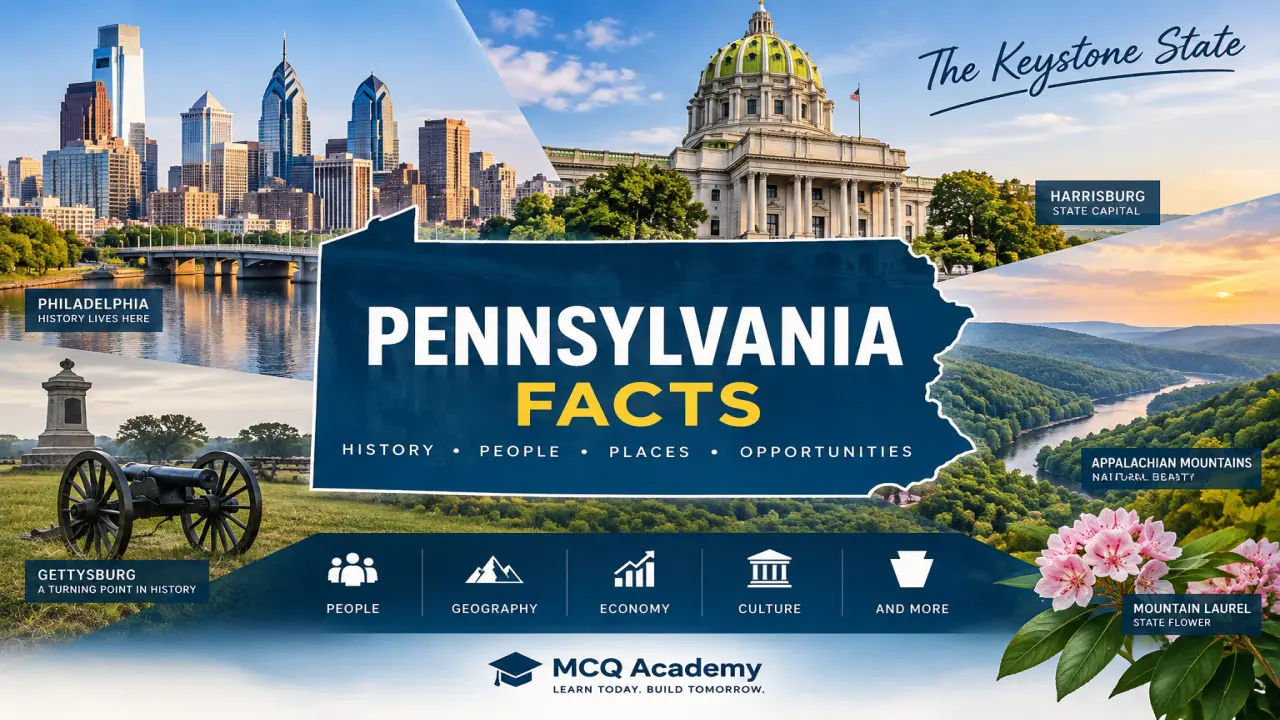
Pennsylvania is one of the most historically important states in the United States, but its significance goes well beyond Philadelphia, the American Revolution, and the steel mills of Pittsburgh. The state crosses several major geographic regions, connects the Atlantic side of the country with the Appalachian interior and Lake Erie, and has a large, diversified modern economy.
Harrisburg is the capital of Pennsylvania, while Philadelphia is its largest city. Pennsylvania was the second state to ratify the U.S. Constitution, on December 12, 1787. Its history includes William Penn’s colonial settlement, the Declaration of Independence, the Constitutional Convention, Valley Forge, the Battle of Gettysburg, coal and steel production, and the growth of major cities and industries.
This Pennsylvania facts guide covers the state’s capital, major cities, population, geography, climate, economy, GDP, history, landmarks, state symbols, and other information useful for students, teachers, quiz learners, and general readers.
Quick Facts About Pennsylvania
| Fact | Information |
|---|---|
| State name | Pennsylvania |
| Traditional designation | Commonwealth of Pennsylvania |
| Postal abbreviation | PA |
| Capital | Harrisburg |
| Largest city | Philadelphia |
| U.S. Census region | Northeast |
| U.S. Census division | Middle Atlantic |
| Statehood | December 12, 1787 |
| Statehood order | 2nd |
| Total area | About 46,054 square miles |
| Land area | 44,742.27 square miles in the 2020 Census geographic data |
| Population | 13,059,432 – U.S. Census Bureau estimate for July 1, 2025 |
| Population rank | 5th among the states – Vintage 2025 estimates |
| 2020 population density | 290.6 people per square mile |
| Counties | 67 |
| Nickname | The Keystone State |
| Motto | Virtue, Liberty and Independence |
| State bird | Ruffed grouse |
| State flower | Mountain laurel |
| State tree | Eastern hemlock |
| State animal | White-tailed deer |
| State fish | Brook trout |
| Highest point | Mount Davis – 3,213 feet above sea level |
| Major rivers | Delaware, Susquehanna, Allegheny, Monongahela, and Ohio |
| Time zone | Eastern Time |
The words “state” and “commonwealth” do not give Pennsylvania different legal status from other U.S. states. “Commonwealth” is a traditional designation also used by Kentucky, Massachusetts, and Virginia.
Where Is Pennsylvania Located?
Pennsylvania is in the eastern United States. The U.S. Census Bureau places it in the Northeast Region and the Middle Atlantic Division, together with New York and New Jersey. Geographically, however, Pennsylvania also has strong Appalachian, Mid-Atlantic, and Great Lakes connections.
Pennsylvania on the U.S. Map
The state stretches from the Delaware River in the east to Ohio in the west. The Appalachian Mountains cross Pennsylvania from southwest to northeast, while the northwestern corner reaches Lake Erie. This location helped Pennsylvania become an important transportation, industrial, agricultural, and commercial link between the Atlantic seaboard and the interior of the country.
What States Border Pennsylvania?
Pennsylvania has land borders with six states: New York State to the north; New Jersey to the east; Delaware and Maryland to the south and southeast; West Virginia to the southwest; and Ohio to the west. Lake Erie forms part of Pennsylvania’s northwestern boundary.
The Delaware River forms much of the eastern boundary with New Jersey. Pennsylvania’s southern boundary with Maryland is also associated with the historic Mason-Dixon Line, which became an important geographic and cultural reference in U.S. history.
Pennsylvania’s Area and Size
Pennsylvania covers about 46,054 square miles in total. U.S. Census geographic data report 44,742.27 square miles of land. The rest includes inland water and part of Lake Erie. The state is large enough to contain substantial differences in elevation, climate, settlement, agriculture, and regional identity.
Geography of Pennsylvania
Pennsylvania’s geography is much more varied than a simple description of an Appalachian state suggests. The Pennsylvania Department of Conservation and Natural Resources divides the state into six physiographic provinces: Central Lowlands, Appalachian Plateaus, Ridge and Valley, New England, Piedmont, and Atlantic Coastal Plain.
The Appalachian Plateaus, Ridge and Valley, and Piedmont provinces together cover most of Pennsylvania. These landforms have influenced where cities developed, where people farmed, how transportation routes were built, and where coal and other natural resources were extracted.
Appalachian Mountains and Ridges
The Appalachian system runs diagonally through Pennsylvania. In central parts of the state, long parallel ridges and valleys are especially noticeable. These landforms historically affected travel and settlement because transportation routes often followed river valleys, gaps, and lower passes through the mountains.
The Appalachians also connect Pennsylvania geographically with neighboring states such as West Virginia, where mountain geography and coal resources have also had a major influence on settlement and economic development.
Allegheny Plateau and the Poconos
Much of northern and western Pennsylvania lies within the Appalachian Plateaus province. The Allegheny Plateau contains forested uplands, deeply cut valleys, and areas historically associated with coal, oil, natural gas, timber, and manufacturing.
The Pocono Mountains are a well-known part of northeastern Pennsylvania. Although the Poconos are commonly described as a mountain region, official physiographic classifications place the landscape within broader geological provinces rather than treating the Poconos as a separate statewide province.
Major Rivers and Watersheds
Rivers are central to Pennsylvania’s geography and history. The Susquehanna River crosses central Pennsylvania and flows past Harrisburg before continuing toward Chesapeake Bay. The Delaware River helps form Pennsylvania’s eastern boundary and passes the Philadelphia region on its way toward Delaware Bay.
In Pittsburgh, the Allegheny River from the north and the Monongahela River from the south meet to form the Ohio River. That river system helped connect western Pennsylvania with the Ohio Valley and, eventually, the Mississippi River system.
Lake Erie and Northwestern Pennsylvania
Pennsylvania reaches Lake Erie in the state’s northwestern corner. The city of Erie developed along this Great Lakes connection. Lake Erie affects local transportation, recreation, agriculture, and weather, especially winter snowfall.
Highest Point and Natural Resources
Mount Davis, in Somerset County, is Pennsylvania’s highest point at 3,213 feet above sea level. Pennsylvania also contains extensive forests and important deposits of coal, natural gas, and other geological resources. These resources strongly influenced the state’s industrial history and still matter to parts of its modern economy.
Climate and Weather in Pennsylvania
Pennsylvania has four distinct seasons, but climate conditions differ significantly across the state. Southeastern Pennsylvania generally has milder winters than higher elevations and northern areas. Mountain elevation can lower temperatures and increase snowfall, while Lake Erie strongly influences weather in the northwest.
Lake-effect snow can produce especially heavy winter snowfall near Erie and other parts of northwestern Pennsylvania. Central mountain areas also experience colder conditions than many lower-elevation valleys.
Long-term climate is different from daily weather. NOAA’s 2022 Pennsylvania State Climate Summary reported that statewide average temperatures had increased by almost 2 degrees Fahrenheit since the beginning of the 20th century through its study period. It also documented increases in extreme precipitation. Those observations describe long-term trends, not what the weather will be on any particular day.
What Is the Capital of Pennsylvania?
Harrisburg is the capital of Pennsylvania. It lies along the Susquehanna River in south-central Pennsylvania and is the seat of the Commonwealth’s state government.
Harrisburg has not always been the capital. Philadelphia served as Pennsylvania’s early capital, and the state government moved to Lancaster in 1799. Harrisburg became the permanent state capital in 1812. Its more central location made it better positioned for a state whose settlement and economic activity had expanded far beyond southeastern Pennsylvania.
The capital should not be confused with the state’s largest city. Harrisburg had an estimated population of 50,522 on July 1, 2025, according to the U.S. Census Bureau’s Vintage 2025 estimates. Philadelphia, by comparison, had more than 1.57 million residents.
Major Cities in Pennsylvania
Pennsylvania has two especially large urban centers – Philadelphia in the southeast and Pittsburgh in the southwest – plus several smaller cities that anchor important regional economies. The following figures are U.S. Census Bureau population estimates for July 1, 2025, not metropolitan-area populations.
| City | July 1, 2025 population estimate | Regional importance |
|---|---|---|
| Philadelphia | 1,574,281 | Largest city; major center of history, healthcare, education, finance, transportation, and culture |
| Pittsburgh | 307,632 | Major western Pennsylvania center with industrial heritage and a modern healthcare, education, technology, and services economy |
| Allentown | 126,044 | Major Lehigh Valley city |
| Reading | 95,832 | Regional center in Berks County |
| Erie | 91,838 | Northwestern city on Lake Erie |
| Bethlehem | 79,644 | Lehigh Valley city with major industrial and educational history |
| Scranton | 75,514 | Northeastern Pennsylvania center associated historically with anthracite coal and railroads |
| Lancaster | 58,366 | South-central regional center surrounded by important agricultural areas |
| Harrisburg | 50,522 | State capital and government center |
Philadelphia
Philadelphia is Pennsylvania’s largest city and one of the country’s most important historic cities. The Pennsylvania State House, now called Independence Hall, was the setting for major events connected with both the Declaration of Independence and the U.S. Constitution.
Philadelphia later developed into a major center for manufacturing, transportation, medicine, universities, finance, scientific research, and culture. The city remains the economic and population center of southeastern Pennsylvania and the broader Delaware Valley.
Pittsburgh
Pittsburgh developed where the Allegheny and Monongahela rivers join to form the Ohio River. That location helped make it an important transportation and industrial center.
The Pittsburgh region became internationally associated with iron and steel production during the industrial era. Heavy industry is still part of the region’s history and identity, but the modern Pittsburgh economy is much more diversified, with major activity in healthcare, higher education, engineering, technology, finance, professional services, and advanced manufacturing.
Other Important Pennsylvania Cities
Allentown and Bethlehem are major cities in the Lehigh Valley. Erie is Pennsylvania’s principal city on Lake Erie. Scranton and nearby communities grew partly through the anthracite coal economy. Lancaster is closely connected to one of the state’s most productive agricultural regions, while Harrisburg is the center of state government.
Population of Pennsylvania
The U.S. Census Bureau estimated Pennsylvania’s population at 13,059,432 on July 1, 2025. Under the Census Bureau’s Vintage 2025 estimates, Pennsylvania was the fifth-most-populous state in the country.
The 2020 Census counted 13,002,700 residents. Within the Census Bureau’s Vintage 2025 estimate series, the population increased only modestly from the April 1, 2020 estimates base to July 1, 2025. Population change is not evenly distributed: some cities and suburban areas have grown while other communities have experienced slower growth or decline.
Pennsylvania’s population is concentrated heavily in the Philadelphia region in the southeast and the Pittsburgh region in the southwest, with additional population centers in the Lehigh Valley, Harrisburg area, northeastern Pennsylvania, Lancaster-York corridor, and Erie. Large rural areas remain in the northern, central, and Appalachian parts of the state.
Economy of Pennsylvania
Pennsylvania has one of the country’s larger and more diversified state economies. Its economic history is closely associated with agriculture, coal, iron, steel, railroads, oil, natural gas, and manufacturing. Today’s economy also depends heavily on healthcare, education, professional services, finance, trade, logistics, technology, food production, and other service industries.
Manufacturing and Industrial Heritage
Coal and steel helped make Pennsylvania a center of U.S. industrialization. Pittsburgh became famous for steel, while eastern Pennsylvania developed major iron, steel, railroad, textile, machinery, and other manufacturing operations. The Lehigh Valley and anthracite regions were also deeply connected to mining and industrial production.
Manufacturing remains economically important, but describing modern Pennsylvania simply as a coal-and-steel economy would be misleading. Current production includes chemicals, food products, fabricated metals, machinery, pharmaceuticals, transportation equipment, and other manufactured goods.
Agriculture
Agriculture is important across Pennsylvania, especially in the south-central and southeastern parts of the state. USDA’s 2025 state overview reported about 48,400 farm operations covering 7.1 million acres.
Dairy farming remains significant, and Pennsylvania also produces poultry, corn, hay, soybeans, apples, mushrooms, wheat, peaches, pumpkins, and other products. USDA data for 2025 recorded about 9.7 billion pounds of milk production and more than 452 million pounds of Agaricus mushrooms. These figures refer specifically to the 2025 agricultural reporting period and should be updated when newer complete annual data are used.
Energy and Natural Resources
Pennsylvania has a long energy history that includes coal, petroleum, natural gas, and electricity generation. Much of the state lies above the Marcellus Shale, a major natural-gas-producing formation in the Appalachian Basin.
The U.S. Energy Information Administration reported that Pennsylvania was the nation’s second-largest natural gas producer in 2023. In the state’s 2024 electricity profile, natural gas was the largest source of in-state electricity generation, and Pennsylvania ranked third among the states in total net electricity generation for that year. Nuclear power also supplies a substantial share of Pennsylvania’s electricity.
Energy geography also connects Pennsylvania with neighboring industrial states such as Ohio, while the Appalachian coal and natural gas regions extend across multiple state borders.
Healthcare, Education, Technology, and Services
Healthcare and education are major employers across Pennsylvania. Philadelphia and Pittsburgh contain large healthcare systems, universities, research institutions, and professional-service industries. Finance, insurance, logistics, retail and wholesale trade, tourism, scientific research, and technology also contribute to the state’s economy.
This mix illustrates an important point: Pennsylvania’s industrial history remains essential for understanding the state, but its current economy is broader than the industries for which it was best known in the 19th and 20th centuries.
GDP of Pennsylvania
Gross domestic product, or GDP, measures the value of goods and services produced within an economy. State GDP can be reported in current dollars or in inflation-adjusted, or “real,” dollars, so the two measures should not be confused.
For the first quarter of 2026, U.S. Bureau of Economic Analysis data reported Pennsylvania’s current-dollar GDP at an annualized rate of approximately $1.097 trillion. The corresponding real GDP measure was approximately $830.9 billion in chained 2017 dollars. Both are seasonally adjusted annual rates for Q1 2026, not the dollar value of production during only the three months from January through March.
These numbers are time-sensitive and subject to revision. As of September 23, 2026, BEA’s latest state GDP release covered Q1 2026. BEA scheduled its next state GDP release and annual regional-data update for September 30, 2026. Readers comparing Pennsylvania with another state should therefore use the same BEA release, period, and GDP measure for both states.
Brief History of Pennsylvania
Indigenous Peoples Before European Colonization
People lived in the region now called Pennsylvania for thousands of years before European colonization. Different Indigenous peoples lived, traveled, hunted, farmed, traded, and formed political relationships across different parts of the region at different times.
The Lenape were closely associated with southeastern Pennsylvania and the Delaware Valley. The Susquehannock lived along parts of the Susquehanna River system, while Shawnee and other peoples were present in parts of the region. The Haudenosaunee, or Iroquois Confederacy, also exercised substantial political influence in Pennsylvania during parts of the colonial period. It would be inaccurate to describe the entire modern state as having belonged to one Indigenous nation throughout its history.
William Penn and the Founding of Pennsylvania
King Charles II granted William Penn a royal charter for Pennsylvania in 1681. Penn, a Quaker, promoted the colony as a place where people could practice religion with greater freedom than was common in much of Europe at the time.
Penn founded Philadelphia near the Delaware River and developed a colonial government based on representative institutions. Early relations between Penn’s government and the Lenape included treaties and negotiations, although Indigenous-colonial relations changed substantially over time as immigration, land purchases, colonial expansion, and political pressures increased.
Colonial Pennsylvania
Pennsylvania attracted settlers from different religious, cultural, and linguistic backgrounds. Farming expanded across fertile southeastern valleys, while Philadelphia became one of the largest and most economically important cities in British North America.
The colony’s location, population, agriculture, printing industry, commerce, and transportation connections made Pennsylvania increasingly important in colonial politics and trade.
Pennsylvania and American Independence
Philadelphia became a central meeting place during the movement toward American independence. The Second Continental Congress met in the Pennsylvania State House, the building now known as Independence Hall.
Congress approved the Declaration of Independence there in July 1776. Eleven years later, delegates met in the same building for the Constitutional Convention of 1787 and produced the U.S. Constitution.
Pennsylvania was also the site of the Continental Army’s winter encampment at Valley Forge in 1777-1778. Soldiers faced shortages and disease, while military training and organizational reforms helped improve the army. The historical record is more complicated than the common story that a single harsh winter alone transformed the Continental Army.
Pennsylvania Becomes the Second State
Pennsylvania ratified the U.S. Constitution on December 12, 1787, becoming the second state to do so. Delaware had ratified the Constitution five days earlier, becoming the first state.
If you’re reviewing the larger national structure, see how many states are in the United States of America.
Pennsylvania and the Civil War
The Battle of Gettysburg was fought in southern Pennsylvania from July 1 through July 3, 1863. Union forces under Maj. Gen. George G. Meade defeated Confederate Gen. Robert E. Lee’s attempt to continue his invasion of the North.
On November 19, 1863, President Abraham Lincoln delivered the Gettysburg Address during the dedication of the Soldiers’ National Cemetery. The short speech connected the sacrifices of the Civil War with the principles of equality, national unity, and representative government.
Industrial Pennsylvania
During the 19th and early 20th centuries, Pennsylvania became one of America’s major industrial centers. Coal from the Appalachian regions fueled homes, factories, railroads, and iron and steel production. Pittsburgh became closely identified with steel, while industrial cities and towns developed across both eastern and western Pennsylvania.
Railroads, canals, mines, mills, factories, and later oil and natural gas shaped both the economy and the movement of people. Industrial growth drew immigrants and migrants from many backgrounds, transforming Pennsylvania’s cities and communities.
Pennsylvania in the Modern Era
Many traditional heavy industries declined or changed during the later 20th century. Some communities lost factories, mines, and population, while others developed new economic strengths. Healthcare, education, technology, logistics, energy, finance, advanced manufacturing, and professional services became increasingly important.
Government and Political Geography of Pennsylvania
Pennsylvania’s government has executive, legislative, and judicial branches. The Pennsylvania General Assembly is bicameral, consisting of a Senate and a House of Representatives. Under the current constitutional structure, the Senate has 50 districts and the House has 203 districts.
The state is divided into 67 counties. Pennsylvania also uses several kinds of municipal government, including cities, boroughs, townships, and incorporated towns. Harrisburg is the seat of state government.
The traditional word “Commonwealth” in Pennsylvania’s name does not make it constitutionally different from a state. Pennsylvania has the same status in the federal system as the other states.
Education in Pennsylvania
Pennsylvania has a large network of public school districts, community colleges, state-related universities, public universities, and private colleges and universities.
Major higher-education institutions include Pennsylvania State University, the University of Pittsburgh, the University of Pennsylvania, Carnegie Mellon University, Temple University, and many other public and private institutions. Philadelphia and Pittsburgh are especially important centers for higher education, medicine, engineering, scientific research, and professional training.
These institutions are included here for their educational and research significance, not as a ranking of Pennsylvania colleges or universities.
Famous Places, Historic Sites, and Landmarks in Pennsylvania
| Place | Why it is important |
|---|---|
| Independence Hall | Associated with the Declaration of Independence and the U.S. Constitution |
| Liberty Bell | Historic Philadelphia symbol that later became strongly associated with liberty and abolition |
| Gettysburg National Military Park | Preserves the site of the July 1-3, 1863 Battle of Gettysburg |
| Valley Forge National Historical Park | Preserves the site of the Continental Army’s 1777-1778 winter encampment |
| Pennsylvania State Capitol | Seat of the Commonwealth’s government in Harrisburg |
| Presque Isle State Park | Peninsula on Lake Erie important for recreation and Great Lakes geography |
| Allegheny National Forest | Large federally managed forest in northwestern Pennsylvania |
| Mount Davis | Highest point in Pennsylvania at 3,213 feet |
Pennsylvania State Symbols
| Symbol | Pennsylvania designation |
|---|---|
| Traditional nickname | The Keystone State |
| Motto | Virtue, Liberty and Independence |
| State bird | Ruffed grouse |
| State flower | Mountain laurel |
| State tree | Eastern hemlock |
| State animal | White-tailed deer |
| State fish | Brook trout |
| State insect | Firefly |
| State beverage | Milk |
The nickname “Keystone State” has been associated with Pennsylvania for more than two centuries. Pennsylvania government historical material notes that there isn’t one single, firmly documented origin for the nickname. It came to reflect the state’s important position in the country’s political, economic, and social development.
Interesting Facts About Pennsylvania
- Pennsylvania was the second state to ratify the U.S. Constitution, on December 12, 1787.
- Philadelphia was Pennsylvania’s early capital before the state government moved to Lancaster in 1799 and Harrisburg in 1812.
- Independence Hall is associated with both the Declaration of Independence and the U.S. Constitution.
- Pennsylvania officially uses the traditional designation “Commonwealth,” but that does not give it different constitutional status from another state.
- The Pennsylvania Department of Conservation and Natural Resources recognizes six physiographic provinces within the state.
- The Allegheny and Monongahela rivers meet at Pittsburgh to form the Ohio River.
- Mount Davis is Pennsylvania’s highest point at 3,213 feet above sea level.
- Pennsylvania has access to Lake Erie in its northwestern corner.
- The Battle of Gettysburg took place in Pennsylvania from July 1-3, 1863.
- Abraham Lincoln delivered the Gettysburg Address on November 19, 1863.
- The U.S. Census Bureau estimated Pennsylvania’s population at 13,059,432 on July 1, 2025, making it the fifth-most-populous state in the Vintage 2025 estimates.
- The U.S. Energy Information Administration reported Pennsylvania as the second-largest U.S. natural gas producer in 2023.
- USDA’s 2025 agriculture data recorded more than 452 million pounds of Agaricus mushroom production in Pennsylvania.
Pennsylvania Facts for Students
- Capital: Harrisburg
- Largest city: Philadelphia
- Postal abbreviation: PA
- Nickname: The Keystone State
- Statehood: December 12, 1787
- Statehood order: 2nd
- U.S. Census region: Northeast
- Bordering states: New York, New Jersey, Delaware, Maryland, West Virginia, and Ohio
- Highest point: Mount Davis, 3,213 feet
- Important rivers: Delaware, Susquehanna, Allegheny, Monongahela, and Ohio
- Major geographic feature: Appalachian Mountains
- Population: 13,059,432 in the U.S. Census Bureau’s July 1, 2025 estimate
- Major economic activities: healthcare, education, manufacturing, professional services, finance, agriculture, energy, trade, and logistics
- Founder of colonial Pennsylvania: William Penn
- Major historic sites: Independence Hall, Valley Forge, and Gettysburg
Pennsylvania MCQ Quiz
Which city is the largest in Pennsylvania?
Which part of the United States contains Pennsylvania?
Which U.S. Census region includes Pennsylvania?
Which U.S. Census division includes Pennsylvania?
Which state borders Pennsylvania to the north?
Which state borders Pennsylvania to the east?
Which state borders Pennsylvania to the southeast?
Which state borders Pennsylvania to the south?
Which state borders Pennsylvania to the southwest?
Which Great Lake does Pennsylvania reach in its northwestern corner?
Which river forms much of Pennsylvania’s eastern boundary?
Which two rivers meet at Pittsburgh?
Which idea about Pennsylvania quiz design is most accurate?
What should a student understand about Pennsylvania quiz design?
Which statement correctly explains Pennsylvania quiz design?
Frequently Asked Questions About Pennsylvania
What is Pennsylvania known for?
Pennsylvania is known for its major role in the founding of the United States, including events connected with the Declaration of Independence and the Constitution in Philadelphia. It is also known for Gettysburg, Valley Forge, the Appalachian Mountains, Pittsburgh’s industrial history, coal and steel, agriculture, and a large modern economy.
What is the capital of Pennsylvania?
Harrisburg is the capital of Pennsylvania. The state government moved there in 1812 after earlier periods in Philadelphia and Lancaster.
What is the largest city in Pennsylvania?
Philadelphia is Pennsylvania’s largest city. The U.S. Census Bureau estimated its population at 1,574,281 on July 1, 2025.
Where is Pennsylvania located?
Pennsylvania is in the eastern United States. The U.S. Census Bureau classifies it in the Northeast Region and Middle Atlantic Division. The state also crosses the Appalachian region and reaches Lake Erie in the northwest.
What states border Pennsylvania?
Pennsylvania borders New York, New Jersey, Delaware, Maryland, West Virginia, and Ohio. It also reaches Lake Erie in the northwest.
What is Pennsylvania’s population?
The U.S. Census Bureau estimated Pennsylvania’s population at 13,059,432 on July 1, 2025. That figure comes from the Vintage 2025 population estimates and should not be treated as a permanent population count.
What is Pennsylvania’s GDP?
BEA data for Q1 2026 reported Pennsylvania’s current-dollar GDP at an annualized rate of about $1.097 trillion. Because state GDP figures are revised and released quarterly, the quarter and measurement method should always accompany the number.
What are Pennsylvania’s major industries?
Pennsylvania has a diversified economy that includes healthcare, education, manufacturing, professional and business services, finance, trade, logistics, agriculture, energy, tourism, and technology. Coal and steel remain historically important, but they no longer describe the whole state economy.
What mountains are in Pennsylvania?
The Appalachian Mountains cross Pennsylvania. Important geographic areas include the Ridge and Valley region, the Appalachian Plateaus, the Allegheny Plateau, and the Pocono Mountains.
What are the major rivers in Pennsylvania?
Major Pennsylvania rivers include the Delaware, Susquehanna, Allegheny, Monongahela, and Ohio. The Allegheny and Monongahela join at Pittsburgh to form the Ohio River.
When did Pennsylvania become a state?
Pennsylvania ratified the U.S. Constitution on December 12, 1787, making it the second state to ratify the Constitution after Delaware.
Why is Pennsylvania important in U.S. history?
Pennsylvania was central to several major periods of U.S. history. Philadelphia hosted the Continental Congress and Constitutional Convention; Valley Forge was a major Revolutionary War encampment; Pennsylvania became the second state to ratify the Constitution; Gettysburg was the site of a major Civil War battle; and Pennsylvania later became one of the country’s leading industrial states.
Why is Pennsylvania called the Keystone State?
“The Keystone State” is Pennsylvania’s traditional nickname. Historical explanations connect the term with Pennsylvania’s important political, geographic, economic, and social position in the early United States, but Pennsylvania government historical material cautions that there is no single firmly documented origin for the nickname.
Sources and Data Notes
This article prioritizes government and institutional sources. Population and city estimates use U.S. Census Bureau Vintage 2025 data. GDP figures use U.S. Bureau of Economic Analysis Q1 2026 state accounts. Geographic information draws on U.S. Census geographic data, the U.S. Geological Survey, and the Pennsylvania Department of Conservation and Natural Resources. Climate information uses NOAA material. Agricultural figures use USDA National Agricultural Statistics Service data. Energy information uses the U.S. Energy Information Administration. Historical information is cross-checked with the National Park Service, Library of Congress, U.S. Senate historical records, and Pennsylvania government sources.
Data reviewed: September 23, 2026. Population estimates and economic statistics can change when agencies publish new data or revisions. In particular, BEA scheduled its next state GDP release and annual regional update for September 30, 2026.