

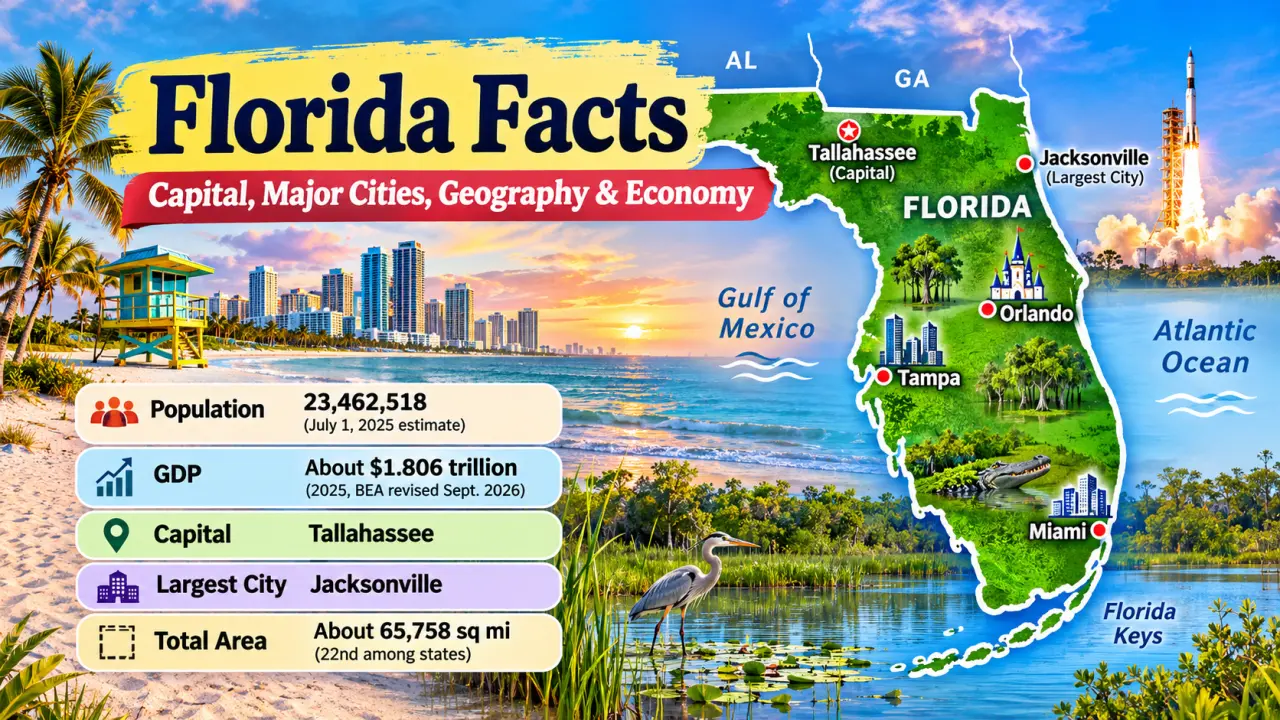
Florida is the third-most-populous U.S. state, a peninsula between the Atlantic Ocean and the Gulf of Mexico, and home to some of the country’s best-known wetlands, beaches, cities, and spaceflight facilities. Tallahassee is the capital; Jacksonville is the largest incorporated city by population. Miami, Tampa, and Orlando lead other major metropolitan and economic centers.
The U.S. Census Bureau estimated 23,462,518 Florida residents on July 1, 2025. The state’s 2025 current-dollar GDP was about $1.806 trillion, according to revised Bureau of Economic Analysis (BEA) figures released September 30, 2026. Those numbers describe two different things: how many people live in Florida and the value of economic production there.
This guide connects Florida’s physical geography with its history, settlement patterns, industries, and environmental challenges. It includes dated statistics, quick revision notes, and questions for geography, history, and economics learners.
Data reviewed: October 31, 2026. Population figures use the Census Bureau’s Vintage 2025 estimates; annual GDP figures use BEA’s September 2026 revisions.
Quick Facts About Florida
| Fact | Florida information |
|---|---|
| Official name | State of Florida |
| Abbreviation | FL |
| Nickname | Sunshine State |
| Capital | Tallahassee |
| Largest incorporated city | Jacksonville |
| U.S. region | Southeast; South Atlantic Census division |
| Statehood | March 3, 1845 – 27th state |
| Neighbors by land | Alabama and Georgia |
| Counties | 67 |
| Total area | About 65,758 square miles (Florida Department of State) |
| Land area | 53,652.17 square miles (2020 Census) |
| Total-area ranking | 22nd among states |
| Population | 23,462,518 (July 1, 2025 estimate) |
| Population ranking | 3rd (July 2025 estimate) |
| Population density | 401.4 people per square mile (2020 Census) |
| Highest natural point | Britton Hill – 345 feet |
| Largest freshwater lake | Lake Okeechobee |
| Major rivers | St. Johns, Suwannee, Apalachicola, Kissimmee |
| State bird | Northern mockingbird |
| State flower | Orange blossom |
| State tree | Sabal palm |
| State animal | Florida panther |
| Motto | In God We Trust |
| Time zones | Eastern; Central in part of the western Panhandle |
| Nominal GDP | About $1.806 trillion (2025, BEA revised September 2026) |
| GDP ranking | 4th by 2025 current-dollar state GDP |
How to read the table: The land-area and population-density values are tied to the 2020 Census. The population and GDP values refer to 2025. The Florida Department of State reports about 53,625 square miles of land using its own geographic summary, whereas the Census Bureau reports 53,652.17 square miles in its 2020 geographic dataset. These are different published measurements, not interchangeable figures. See the Florida Department of State quick facts and Census Bureau QuickFacts.
Continue reading “Florida Facts: Capital, Major Cities, Geography & Economy”