


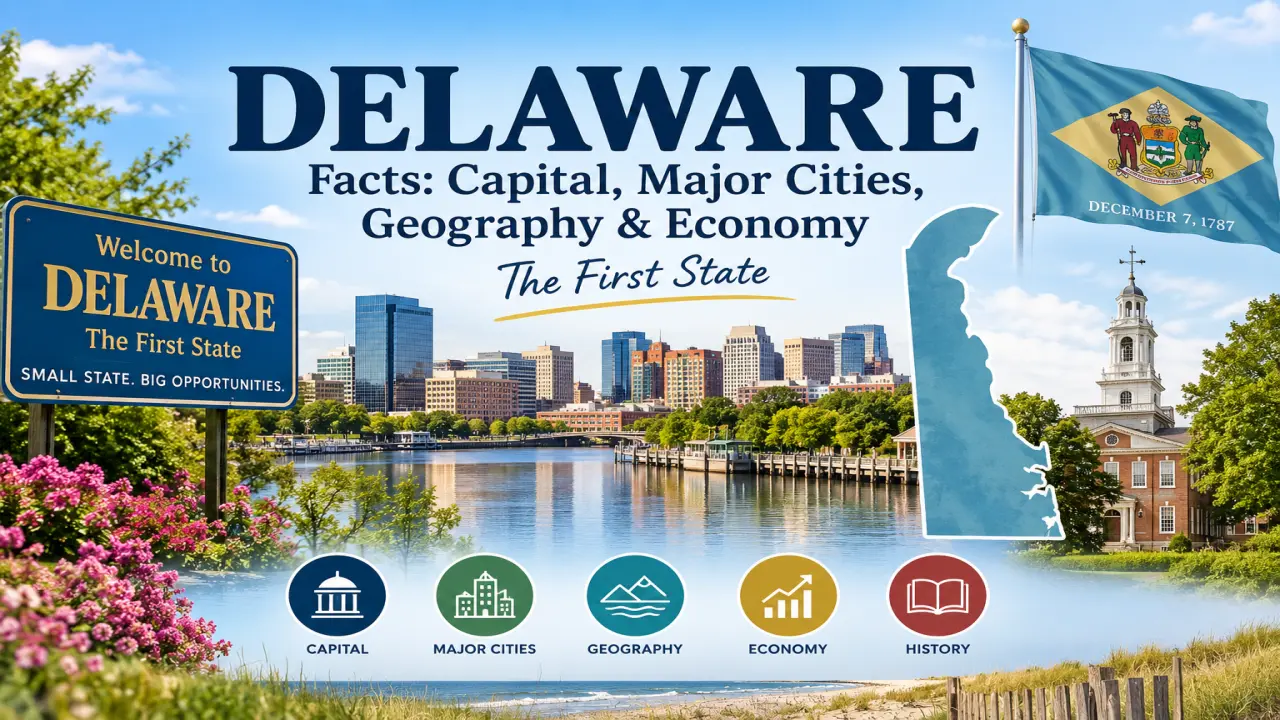
Delaware sits on the eastern edge of the United States between the large cities of the Northeast and the farms, wetlands, bays, and beaches of the Delmarva Peninsula. It is the second-smallest U.S. state by area, yet it has played an unusually large role in American history, corporate law, banking, and finance.
Dover is Delaware’s capital, while Wilmington is its largest city and main financial center. Most of the state is low and flat, with the Atlantic Coastal Plain covering central and southern Delaware and a small stretch of hillier Piedmont terrain in the north.
Delaware is best known as “The First State” because it became the first of the original 13 states to ratify the U.S. Constitution, doing so on December 7, 1787. Today, the state is also known for its business-law system, banking and financial services, poultry farming, Atlantic beaches, and steadily growing population.
Quick Facts About Delaware
| Fact | Delaware |
| Official name | State of Delaware |
| Postal abbreviation | DE |
| Capital | Dover |
| Largest city | Wilmington |
| Region | Mid-Atlantic |
| Nickname | The First State |
| Motto | Liberty and Independence |
| U.S. Constitution ratified | December 7, 1787 |
| Statehood order | 1st |
| Land area | About 1,949 square miles |
| Population | 1,059,952 — July 1, 2025 estimate |
| Counties | 3 |
| Counties by name | New Castle, Kent, and Sussex |
| Highest point | Ebright Azimuth |
| Highest elevation | About 448 feet above sea level |
| Lowest elevation | Sea level |
| State bird | Blue Hen chicken |
| State flower | Peach blossom |
| State tree | American holly |
| State colors | Colonial blue and buff |
| State song | “Our Delaware” |
| Time zone | Eastern Time |
| Major bodies of water | Delaware River, Delaware Bay, Atlantic Ocean |
The U.S. Census Bureau lists Delaware’s 2020 land area at 1,948.55 square miles. The state is about 96 miles from north to south and ranges from roughly 9 to 35 miles wide.
Where Is Delaware Located?
Delaware is on the Eastern Seaboard of the United States, on the northeastern side of the Delmarva Peninsula. It is usually grouped with the Mid-Atlantic states.
Maryland borders Delaware to the west and south and shares much of the Delmarva Peninsula with it. Pennsylvania lies to the north, while New Jersey lies across portions of the Delaware River and Delaware Bay to the east. The Atlantic Ocean borders Delaware’s southeastern coast.
Its location puts Delaware close to several large metropolitan areas. Wilmington is only a short distance from Philadelphia, while Baltimore and Washington, D.C., are also within the wider regional corridor.
How Large Is Delaware?
Delaware is the second-smallest U.S. state by area. Only Rhode Island is smaller.
That compact size creates an interesting contrast. Wilmington’s urban neighborhoods, Kent County farmland, coastal wetlands, and Atlantic beaches can all be found within a relatively short drive.
The Census Bureau records about 1,949 square miles of land in Delaware. Water is also a major part of its geography, with the Delaware River, Delaware Bay, coastal bays, wetlands, and Atlantic Ocean shaping much of the eastern side of the state.
Geography of Delaware
For such a small state, Delaware has a clear geographic divide. Northern Delaware and the rest of the state do not look quite the same.
Atlantic Coastal Plain
Most of Delaware lies in the Atlantic Coastal Plain. This region covers almost all of Kent and Sussex counties and reaches into southern New Castle County.
The landscape is generally flat and low. Sandy soils, wetlands, streams, tidal areas, forests, and broad stretches of farmland are common. Agriculture has long been important here, especially grain farming and poultry production.
Low elevation also makes water an especially important part of life in Delaware. Drainage, groundwater, tidal flooding, coastal storms, wetlands, and shoreline change all matter in a state where so much land lies close to sea level.
Piedmont Region
The far north of Delaware belongs to the Piedmont, a region of older rock and rolling terrain that continues north into Pennsylvania.
This part of New Castle County is noticeably hillier than southern Delaware. Streams such as Brandywine Creek cut through the landscape, and their flowing water once powered mills and early industries.
The transition between the Piedmont and Coastal Plain helped influence where people settled, where boats could travel, and where early manufacturers built mills. In Delaware, physical geography and economic history are closely connected.
Highest and Lowest Points in Delaware
Delaware does not have mountains. Its highest area is around Ebright Azimuth near the Pennsylvania border in New Castle County.
A benchmark there stands at about 448 feet above sea level. At the opposite extreme, Delaware reaches sea level along its coast.
Rivers, Bays, and Waterways
Water has shaped Delaware’s settlement, transportation, economy, and identity from the beginning.
The Delaware River runs along much of the northeastern side of the state before widening into Delaware Bay. The bay then opens into the Atlantic Ocean.
Other important waterways include the Christina River, Brandywine Creek, Indian River, and Nanticoke River, along with many smaller creeks, coastal bays, and wetlands.
The Christina River and Brandywine Creek were especially important in the development of Wilmington and northern Delaware. Farther south, waterways and wetlands remain closely tied to farming, fisheries, wildlife, and the coastal environment.
Delaware’s Coast and Beaches
Delaware’s Atlantic coast lies mainly in Sussex County. Rehoboth Beach, Bethany Beach, Dewey Beach, and nearby coastal communities attract visitors from Delaware and surrounding states.
Cape Henlopen marks an important point near the meeting of Delaware Bay and the Atlantic Ocean. The coast is not only a tourism area. It also contains dunes, salt marshes, tidal ecosystems, fisheries, and wildlife habitat.
Climate of Delaware
Delaware has a humid climate with four distinct seasons. Summers are generally warm and humid, while winters are cool and usually milder near the coast than farther inland.
The Atlantic Ocean and Delaware Bay help moderate temperatures near the shoreline. Rain falls throughout the year, although yearly totals and seasonal conditions vary.
What Is the Capital of Delaware?
Dover is the capital of Delaware.
It sits in Kent County near the center of the state. Dover is the seat of Delaware’s state government and is home to the General Assembly, state offices, historic government buildings, and other civic institutions.
Why Is Dover the Capital?
Dover was not always Delaware’s capital. New Castle had served as an important colonial seat of government, but the Revolutionary War made its location near the Delaware River more vulnerable.
The capital was moved to Dover in 1777. Its more central position made it a practical place for government, and Dover has remained Delaware’s capital ever since.
Dover Today
Government remains central to Dover’s identity, but the city is also home to Delaware State University and Dover Air Force Base.
The U.S. Census Bureau estimated Dover’s population at 40,592 on July 1, 2025. It is one of Delaware’s largest cities, although it is considerably smaller than Wilmington.
Major Cities in Delaware
Delaware does not have a huge metropolis. Its cities are fairly small by national standards, and many residents live in suburbs, towns, and unincorporated communities outside the central cities.
| City or town | 2025 estimated population | Known for |
| Wilmington | 73,512 | Largest city, finance, banking, and corporate services |
| Dover | 40,592 | State capital |
| Newark | 30,359 | University of Delaware |
| Middletown | 25,798 | Growing New Castle County community |
| Milford | 14,723 | Regional center spanning Kent and Sussex counties |
| Smyrna | 13,340 | Central Delaware community |
| Seaford | 9,165 | Regional center in western Sussex County |
These figures are U.S. Census Bureau population estimates for July 1, 2025.
Wilmington: Delaware’s Largest City
Wilmington is the largest city in Delaware.
It lies in New Castle County near the Christina River and close to the Delaware River. Its position near Philadelphia and along major Northeast transportation routes has helped make Wilmington Delaware’s main urban, business, and financial center.
Wilmington has a long industrial history, but banking, finance, legal services, healthcare, and corporate services now play major roles in the local economy.
Newark
Newark is best known as the home of the University of Delaware. The university gives the city a strong academic character and supports research, education, technology, athletics, and local businesses.
The Census Bureau estimated Newark’s population at 30,359 in 2025.
Middletown
Middletown, in southern New Castle County, has grown rapidly as residential and commercial development has moved farther south from the Wilmington and Newark areas.
Its estimated population reached 25,798 in 2025, making it an increasingly important population center in northern Delaware.
Population of Delaware
The U.S. Census Bureau estimated Delaware’s population at 1,059,952 on July 1, 2025.
For comparison, the 2020 Census counted 989,948 people, while the 2010 Census counted 897,934. The latest estimate series shows Delaware continuing to grow during the first half of the 2020s.
That growth matters in a state as physically small as Delaware. New housing, roads, schools, utilities, and development pressures can become visible quickly when more people are added to a limited amount of land.
Northern New Castle County contains the state’s largest urban and suburban concentration, including Wilmington and Newark. Dover anchors central Delaware, while parts of Sussex County have also experienced substantial growth, especially around coastal and retirement communities.
The Census Bureau reported a population density of about 508 people per square mile in 2020.
Economy of Delaware
Delaware’s economy is much larger and more specialized than its geographic size might suggest.
Finance and insurance are especially important, but Delaware also has substantial activity in healthcare, professional services, government, manufacturing, agriculture, transportation, logistics, and tourism.
Northern and southern Delaware have somewhat different economic profiles. Wilmington and northern New Castle County are closely tied to finance, corporate services, and the larger Northeast economy. Southern Delaware has a stronger agricultural base and a large seasonal tourism economy along the coast.
Banking and Financial Services
Finance is one of Delaware’s most important industries. Wilmington became a major banking and credit-card center during the late 20th century, and financial services remain closely associated with the city today.
The scale is very different from the financial sector in New York State, but finance and insurance make up an unusually large share of Delaware’s economy relative to the state’s size.
Preliminary Bureau of Economic Analysis data put the finance and insurance industry’s current-dollar contribution to Delaware GDP at roughly $30.2 billion in 2025.
Why Do So Many Companies Incorporate in Delaware?
One of the most famous Delaware facts is the number of companies that choose the state as their legal home.
That does not mean all of those businesses have headquarters, offices, factories, or employees in Delaware. A company can be incorporated under Delaware law while carrying out most of its business somewhere else.
Companies choose Delaware for several reasons rather than one simple tax advantage. The state has a well-developed body of corporate law, the flexible Delaware General Corporation Law, an experienced legal community, efficient corporate filing services, and a specialized Court of Chancery.
The Delaware Division of Corporations reported more than 2.1 million active business entities in its 2024 annual report. About two-thirds of Fortune 500 companies were incorporated in Delaware.
Court of Chancery
The Delaware Court of Chancery is an important part of the state’s corporate-law system.
It is a court of equity with deep experience in disputes involving corporations, boards, shareholders, mergers, fiduciary duties, and other business matters. Many cases are decided by judges rather than juries.
Decades of decisions have also built a large body of case law. For companies and lawyers, that can make the legal treatment of corporate questions more predictable than in jurisdictions with less-developed corporate precedent.
Manufacturing and Science
Delaware also has a long industrial and scientific history.
The Brandywine Valley became an early center of mills and manufacturing. Chemical production later became closely associated with Delaware, and the state developed important connections with materials science, pharmaceuticals, research, and advanced manufacturing.
Healthcare
Healthcare and social assistance form another substantial part of Delaware’s economy. Hospitals, medical practices, residential care, and other health services employ people throughout the state and serve a population that now exceeds one million.
Agriculture and Poultry
Agriculture remains especially visible in central and southern Delaware.
Corn, soybeans, and other field crops are important, but poultry is one of the state’s best-known agricultural industries. Broiler chicken production is particularly significant across the Delmarva Peninsula.
Sussex County is closely associated with poultry farming and processing, while cropland covers large areas of Delaware’s Coastal Plain.
Tourism and the Coastal Economy
Delaware’s beaches support hotels, restaurants, shops, recreation businesses, and other seasonal employment.
Rehoboth Beach, Bethany Beach, Dewey Beach, Lewes, and surrounding coastal communities draw visitors from Delaware and neighboring states, giving tourism an especially visible role in Sussex County.
Transportation and Logistics
Delaware benefits from its position between major East Coast metropolitan areas. Interstate 95 crosses northern Delaware, rail lines connect the state with the Northeast Corridor, and the Port of Wilmington handles cargo moving through the Delaware River region.
Does Delaware Have a Sales Tax?
Delaware does not impose a conventional state or local sales tax on consumers.
That is why shoppers generally do not see a sales-tax charge added at checkout. This does not mean Delaware is tax-free. The state collects revenue through other taxes and fees, including a gross receipts tax that applies to many businesses.
GDP of Delaware
Gross domestic product, or GDP, measures the value of goods and services produced within an economy.
Preliminary Bureau of Economic Analysis data put Delaware’s current-dollar GDP at about $117.2 billion in 2025, up from roughly $111.0 billion in 2024.
After adjusting for inflation, Delaware’s real GDP was about $87.3 billion in chained 2017 dollars in 2025, compared with about $85.4 billion in 2024.
Finance and insurance accounted for a particularly large part of current-dollar output. Healthcare, government, professional and technical services, manufacturing, real estate, and other industries also contributed to the state’s economy.
In the first quarter of 2026, the Bureau of Economic Analysis reported that Delaware’s real GDP was essentially unchanged from the previous quarter at an annual rate. GDP estimates are revised as newer information becomes available, so the year or quarter should always be included when citing the figure.
Brief History of Delaware
Delaware’s history began long before it was called the First State.
Indigenous Peoples
Native peoples lived throughout the Delaware Valley and surrounding region long before Europeans arrived.
The Lenape, also called Lenni Lenape, were among the peoples closely associated with northern Delaware and the wider Delaware River region. Rivers, forests, wetlands, and coastal environments supported communities, travel, hunting, fishing, farming, and trade.
Dutch Settlement
Dutch colonists made some of the earliest European attempts to settle Delaware.
In 1631, they established Swanendael near present-day Lewes. The settlement did not survive for long, but it remains an important part of Delaware’s early colonial history.
New Sweden and Fort Christina
In 1638, Swedish and Finnish settlers led by Peter Minuit established New Sweden along the Christina River.
They built Fort Christina at what is now Wilmington. The settlement became a lasting part of the region’s colonial story and left Swedish and Finnish influences that continued even after political control changed.
The Dutch captured New Sweden in 1655. English forces took control of the region in 1664.
William Penn and the Lower Counties
The land that became Delaware later came under the authority of William Penn.
New Castle, Kent, and Sussex were often called the Lower Counties on the Delaware. They were politically connected with Pennsylvania but developed their own interests and identity.
Beginning in 1704, the Delaware counties met in a separate legislative assembly, although Delaware and Pennsylvania continued to share a governor for many years.
Delaware and American Independence
In 1776, the three Delaware counties ended their political relationship with Britain and Pennsylvania and organized themselves as an independent state.
One of Delaware’s best-known Revolutionary figures is Caesar Rodney, remembered for riding to Philadelphia in July 1776 so Delaware’s delegation could support independence.
Delaware shared the Revolutionary experience with the other original states, including Virginia, but Delaware would soon claim a distinction none of them could match: it became the first to ratify the new federal Constitution.
Why Is Delaware Called the First State?
Delaware earned its best-known nickname after the Constitutional Convention.
On December 7, 1787, Delaware became the first state to ratify the newly written U.S. Constitution. The state convention approved ratification unanimously.
Pennsylvania followed Delaware as the second state to ratify the Constitution, and New Jersey became the third later that month.
There is an important historical distinction here. Delaware had already declared itself an independent state in 1776. December 7, 1787, is the date associated with its place as the first state in the new constitutional Union.
Delaware During the Civil War
Delaware was a slave state when the Civil War began, but it remained in the Union.
That position makes Delaware’s Civil War history more complicated than a simple North-versus-South description. Slavery, Union loyalty, abolition, racial inequality, and political disagreement all formed part of the state’s wartime experience.
Industrial and Modern Delaware
Industry developed strongly around Wilmington and the Brandywine Valley, where streams supplied power to early mills.
Manufacturing and chemical production later became important parts of the state economy. During the 20th century, banking and financial services expanded Delaware’s economic role, while its corporate-law system made the state important to businesses far beyond its physical borders.
Delaware’s Three Counties
Delaware has only three counties: New Castle, Kent, and Sussex. No U.S. state has fewer counties.
| County | County seat | Part of Delaware | Known for |
| New Castle | Wilmington | North | Largest population center, finance, industry, and higher education |
| Kent | Dover | Central | State government and agriculture |
| Sussex | Georgetown | South | Agriculture, poultry, beaches, and tourism |
New Castle County
New Castle County is Delaware’s northernmost county and contains the state’s largest concentration of people.
Wilmington, Newark, and Middletown are here. The county also includes Delaware’s small section of the Piedmont as well as flatter Coastal Plain terrain farther south.
Kent County
Kent County occupies central Delaware. Dover, the state capital, is its largest city. Beyond the Dover area, much of the county has a rural and agricultural character.
Sussex County
Sussex County covers southern Delaware. It is strongly associated with farming and poultry production, but it also contains Delaware’s Atlantic beach communities.
That combination gives Sussex County both a substantial agricultural economy and a large tourism sector.
Government of Delaware
Delaware has executive, legislative, and judicial branches like other U.S. states. State government is based in Dover.
The Delaware General Assembly is the state legislature. It has two chambers: the Delaware House of Representatives and the Delaware Senate.
The state’s court system is particularly well known because of the Court of Chancery and Delaware’s importance in American corporate law.
Education in Delaware
University of Delaware
The University of Delaware, based in Newark, is the state’s major public research university. It serves students from Delaware and elsewhere while supporting research, science, engineering, agriculture, business, and other academic fields.
Delaware State University
Delaware State University is a public historically Black university based in Dover. It is another important part of the state’s higher-education system.
Other Colleges and Universities
Delaware Technical Community College serves communities across the state, while Wilmington University and several other institutions add to Delaware’s mix of public and private higher education.
Famous Places and Landmarks in Delaware
First State National Historical Park
First State National Historical Park is not one continuous park. It brings together several places connected with Delaware’s Indigenous history, European settlement, colonial government, and role in the founding of the United States.
Fort Christina
Fort Christina in Wilmington marks the area where Swedish settlers established New Sweden in 1638. The original fort no longer stands, but the site remains an important reminder of Delaware’s Swedish and Finnish colonial history.
Historic New Castle
New Castle preserves streets, houses, and public buildings connected with Delaware’s colonial period. The New Castle Court House is particularly important to the history of government in the Lower Counties and the later state of Delaware.
Dover Green
Dover’s historic Green has been at the center of public life for generations. It is closely connected with Delaware government and the state’s ratification of the U.S. Constitution.
John Dickinson Plantation
The John Dickinson Plantation near Dover preserves part of the story of founding-era politician John Dickinson as well as the lives of the enslaved and free people connected with the property.
Cape Henlopen
Cape Henlopen sits near the entrance to Delaware Bay. Its beaches, dunes, maritime setting, and protected landscapes make it important both geographically and historically.
Rehoboth Beach
Rehoboth Beach is one of Delaware’s best-known Atlantic resort communities. Its beach, boardwalk, restaurants, shops, and surrounding businesses make it an important center of the state’s tourism economy.
Hagley Museum and the Brandywine Valley
The Brandywine Valley helps tell the story of Delaware’s industrial past. Hagley Museum and Library occupies the site of early DuPont powder works along the Brandywine and preserves part of the region’s manufacturing history.
Winterthur
Winterthur Museum, Garden & Library near Wilmington is known for American decorative arts, historical collections, research resources, and extensive gardens.
State Symbols of Delaware
| Symbol | Delaware designation |
| State nickname | The First State |
| State motto | Liberty and Independence |
| State bird | Blue Hen chicken |
| State flower | Peach blossom |
| State tree | American holly |
| State colors | Colonial blue and buff |
| State song | “Our Delaware” |
| State flag | Colonial blue field with a buff diamond containing the state coat of arms |
The state flag includes the date December 7, 1787, directly referring to Delaware’s place as the first state to ratify the Constitution.
What Is Delaware Known For?
Delaware is known for several things that do not seem closely related at first.
It is the First State, the second-smallest state by area, and the state with the fewest counties. It is also one of the country’s most important jurisdictions for corporate law.
Delaware is known for Wilmington’s banking and financial sector, Atlantic beaches, poultry farming, colonial history, and the absence of a conventional state or local sales tax.
That mix explains why Delaware can appear in a U.S. history lesson, a corporate-law case, an agriculture report, and a beach vacation plan without changing states.
Interesting Facts About Delaware
- Delaware was the first state to ratify the U.S. Constitution, on December 7, 1787.
- It is the second-smallest U.S. state by area.
- Delaware has just three counties: New Castle, Kent, and Sussex.
- Dover is the capital, but Wilmington is the largest city.
- Delaware’s highest point is only about 448 feet above sea level.
- Swedish and Finnish settlers established New Sweden along the Christina River in 1638.
- Most of Delaware lies on the flat Atlantic Coastal Plain, while a small section of northern Delaware reaches into the Piedmont.
- The Blue Hen chicken is Delaware’s official state bird.
- The nickname “The First State” refers to Delaware’s place as the first state to ratify the Constitution.
- More than 2 million business entities have chosen Delaware as their legal home, even though Delaware itself has a population of only a little over 1 million.
- Finance and insurance account for an unusually large share of Delaware’s economy.
- The Delaware Court of Chancery is one of the country’s best-known courts for corporate disputes.
- Delaware has no conventional state or local sales tax on consumers, although businesses may pay gross receipts taxes and other taxes.
- The state stretches only about 96 miles from north to south.
- Delaware’s landscapes range from rolling Piedmont country near Pennsylvania to flat farms, wetlands, bays, and Atlantic beaches farther south.
Delaware Facts for Students
| Question | Quick answer |
| What is Delaware’s abbreviation? | DE |
| What is Delaware’s capital? | Dover |
| What is Delaware’s largest city? | Wilmington |
| What is Delaware’s nickname? | The First State |
| Why is it called the First State? | It was the first state to ratify the U.S. Constitution |
| When did Delaware ratify the Constitution? | December 7, 1787 |
| How many counties does Delaware have? | 3 |
| What are Delaware’s counties? | New Castle, Kent, and Sussex |
| What states border Delaware? | Maryland, Pennsylvania, and New Jersey |
| What ocean borders Delaware? | Atlantic Ocean |
| What are Delaware’s main geographic regions? | Atlantic Coastal Plain and Piedmont |
| What is Delaware’s highest point? | Ebright Azimuth |
| What is Delaware’s state bird? | Blue Hen chicken |
| What is Delaware’s state flower? | Peach blossom |
| What is Delaware’s state tree? | American holly |
Delaware MCQ Quiz
What is true about Delaware’s finance and insurance sector?
Which description of Delaware’s finance and insurance sector is accurate?
Which fact best describes Wilmington’s financial role?
Which option accurately explains banking and credit-card operations in Wilmington?
Which option accurately explains Delaware’s Civil War status?
What is the correct interpretation of Southern Delaware?
Which statement best summarizes Delaware’s location on the Delmarva Peninsula?
Which description of a Delaware corporate charter is accurate?
Which fact best describes Delaware as an incorporation choice?
Which option accurately explains the Delaware Court of Chancery?
What is the correct interpretation of path dependence in Delaware corporate law?
Which statement best summarizes the Delaware General Corporation Law?
Which choice gives the correct context for network effects in Delaware corporate law?
Which statement is correct about Delaware’s registered business entities?
Which economic structure statement is correct about Delaware’s finance and insurance sector?
Frequently Asked Questions About Delaware
What is Delaware known for?
Delaware is best known as the First State because it was the first to ratify the U.S. Constitution. It is also known for corporate law, the Court of Chancery, Wilmington’s financial sector, poultry farming, Atlantic beaches, and having no conventional state or local sales tax.
What is the capital of Delaware?
Dover is the capital of Delaware. The capital was moved there from New Castle in 1777. Dover is in Kent County near the center of the state.
What is the largest city in Delaware?
Wilmington is Delaware’s largest city. The U.S. Census Bureau estimated its population at 73,512 on July 1, 2025.
What are the major cities in Delaware?
Delaware’s main cities and larger towns include Wilmington, Dover, Newark, Middletown, Milford, Smyrna, and Seaford. Wilmington is the largest city, while Dover is the state capital.
Why is Delaware called the First State?
Delaware is called the First State because it became the first of the original 13 states to ratify the U.S. Constitution. Delaware’s ratification convention approved the Constitution on December 7, 1787.
When did Delaware become a state?
Delaware declared itself an independent state in 1776. In the usual U.S. statehood sequence, however, its statehood date is given as December 7, 1787, when it became the first state to ratify the Constitution.
How many counties are in Delaware?
Delaware has three counties: New Castle, Kent, and Sussex. No other U.S. state has fewer counties.
What states border Delaware?
Delaware borders Maryland, Pennsylvania, and New Jersey. It also faces Delaware Bay and the Atlantic Ocean.
Is Delaware on the Atlantic Ocean?
Yes. Southern Delaware has an Atlantic coastline that includes well-known beach communities such as Rehoboth Beach, Dewey Beach, and Bethany Beach.
What is the population of Delaware?
The U.S. Census Bureau estimated Delaware’s population at 1,059,952 on July 1, 2025.
What is Delaware’s GDP?
Preliminary Bureau of Economic Analysis data put Delaware’s current-dollar GDP at about $117.2 billion in 2025. GDP estimates are revised over time, so the year and data release should be included whenever the figure is quoted.
What are Delaware’s major industries?
Finance and insurance are especially important to Delaware. Other major parts of the economy include healthcare, professional services, government, manufacturing, agriculture, poultry production, transportation, logistics, and coastal tourism.
Why do so many companies incorporate in Delaware?
Companies choose Delaware for its developed corporate laws, extensive legal precedent, specialized Court of Chancery, experienced corporate-law community, and established system for forming and administering business entities. Incorporating in Delaware does not necessarily mean a company operates or maintains its headquarters there.
Does Delaware have a sales tax?
Delaware has no conventional state or local sales tax charged to consumers at checkout. It does collect other taxes and fees, including a gross receipts tax from many businesses.
Is Delaware the smallest U.S. state?
No. Rhode Island is the smallest U.S. state by area. Delaware is the second-smallest.
What to Remember About Delaware
Delaware is easy to overlook on a map, but its size does not match its importance in American history or business. It occupies a small stretch of the Mid-Atlantic coast, with rolling Piedmont terrain in the north and broad Coastal Plain landscapes across most of the state.
Dover is the capital, Wilmington is the largest city, and New Castle, Kent, and Sussex are the state’s only three counties. More than one million people now live in Delaware, with the largest concentration in the north and continued growth in central and southern parts of the state.
Historically, Delaware passed through Indigenous, Dutch, Swedish, English, and colonial American chapters before becoming an independent state in 1776. Its decision to ratify the U.S. Constitution on December 7, 1787, gave Delaware the lasting nickname “The First State.”
Today, finance, corporate law, healthcare, agriculture, manufacturing, government, and tourism all help shape Delaware’s economy. The state may be small, but its place in U.S. history, law, geography, and business gives students plenty to remember.
Sources and Data Notes
Population, city population, land-area, and population-density figures were checked against the U.S. Census Bureau.
GDP and industry information was checked against the U.S. Bureau of Economic Analysis.
General state facts, government information, and official state designations were checked against Delaware.gov and the Delaware Code.
Geographic and geological information was checked against the Delaware Geological Survey and U.S. Geological Survey resources.
Early colonial and historical information was checked against the National Park Service and official Delaware historical resources.
Corporate-law and incorporation information was checked against the Delaware Division of Corporations.
Data last reviewed: September 2026. Population, GDP, business, and other changing statistics should be checked periodically as new official data are released.