

Pennsylvania Facts: Capital, Major Cities, Geography & Economy

Pennsylvania is one of the most historically important states in the United States, but its significance goes well beyond Philadelphia, the American Revolution, and the steel mills of Pittsburgh. The state crosses several major geographic regions, connects the Atlantic side of the country with the Appalachian interior and Lake Erie, and has a large, diversified modern economy.

Harrisburg is the capital of Pennsylvania, while Philadelphia is its largest city. Pennsylvania was the second state to ratify the U.S. Constitution, on December 12, 1787. Its history includes William Penn’s colonial settlement, the Declaration of Independence, the Constitutional Convention, Valley Forge, the Battle of Gettysburg, coal and steel production, and the growth of major cities and industries.

This Pennsylvania facts guide covers the state’s capital, major cities, population, geography, climate, economy, GDP, history, landmarks, state symbols, and other information useful for students, teachers, quiz learners, and general readers.

Quick Facts About Pennsylvania

FactInformation
State namePennsylvania
Traditional designationCommonwealth of Pennsylvania
Postal abbreviationPA
CapitalHarrisburg
Largest cityPhiladelphia
U.S. Census regionNortheast
U.S. Census divisionMiddle Atlantic
StatehoodDecember 12, 1787
Statehood order2nd
Total areaAbout 46,054 square miles
Land area44,742.27 square miles in the 2020 Census geographic data
Population13,059,432 – U.S. Census Bureau estimate for July 1, 2025
Population rank5th among the states – Vintage 2025 estimates
2020 population density290.6 people per square mile
Counties67
NicknameThe Keystone State
MottoVirtue, Liberty and Independence
State birdRuffed grouse
State flowerMountain laurel
State treeEastern hemlock
State animalWhite-tailed deer
State fishBrook trout
Highest pointMount Davis – 3,213 feet above sea level
Major riversDelaware, Susquehanna, Allegheny, Monongahela, and Ohio
Time zoneEastern Time

The words “state” and “commonwealth” do not give Pennsylvania different legal status from other U.S. states. “Commonwealth” is a traditional designation also used by Kentucky, Massachusetts, and Virginia.

Continue reading “Pennsylvania Facts: Capital, Major Cities, Geography & Economy”

New York State Facts: Capital, Major Cities, Geography & Economy

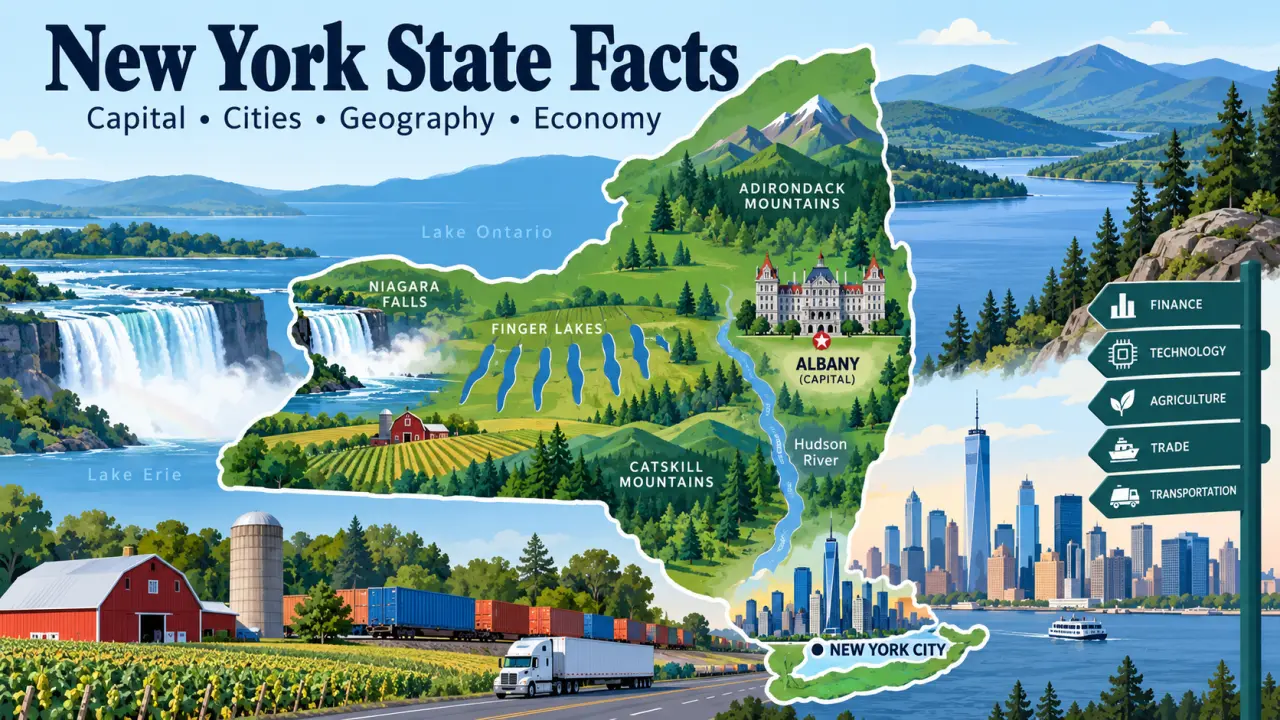
New York State is often pictured through New York City – skyscrapers, Wall Street, Broadway and millions of people packed into a small part of the state. That picture is important, but it is far from complete. New York stretches from the Atlantic coast and Long Island to the Canadian border and from the Hudson Valley west to Lake Erie.

Across that distance are the Adirondack and Catskill mountains, the Finger Lakes, major river valleys, productive farmland, forests, Great Lakes shorelines and cities with very different histories and economies. Albany is the capital, while New York City is the largest city.

This guide looks at New York State as a whole – its geography, capital, major cities, population, economy, GDP, history, government, education, landmarks and state symbols. It is designed as a reference for students, teachers, quiz learners and anyone who wants to understand how the different parts of New York fit together.

Quick Facts About New York State

FactNew York State
Official nameState of New York
Postal abbreviationNY
CapitalAlbany
Largest cityNew York City
U.S. regionNortheastern United States
StatehoodJuly 26, 1788
Order of statehood11th
Land area47,123.4 square miles
Water area7,435.1 square miles
Total areaAbout 54,558.5 square miles
Population20,002,427 – July 1, 2025 Census estimate, Vintage 2025
Population rank4th – July 1, 2025 Census estimates
Approximate population densityAbout 424.5 people per square mile of land, using the 2025 population estimate
Counties62
NicknameThe Empire State
Words on the current state arms“Excelsior” and “E pluribus unum”
Highest pointMount Marcy – 5,344 feet
Great Lakes bordering the stateLake Erie and Lake Ontario
Time zoneEastern Time
State birdEastern bluebird
State mammalBeaver
State flowerRose
State treeSugar maple

The U.S. Census Bureau estimated New York’s population at 20,002,427 on July 1, 2025. In the same Vintage 2025 series, California, Texas and Florida ranked ahead of New York in population.

Continue reading “New York State Facts: Capital, Major Cities, Geography & Economy”
Connecticut Facts: Capital, Major Cities, Geography & Economy

Connecticut is one of the smallest U.S. states by area, but a lot is packed into its borders. It has a coastline on Long Island Sound, wooded hills in the northwest, the Connecticut River running through the middle of the state, old New England towns, major universities, and cities closely tied to the economies of New York and Boston.

Hartford is the state capital, while Bridgeport is the most populous city. Connecticut is also known for insurance, aerospace and defense manufacturing, submarine construction, higher education, and a colonial history that helped give it the official nickname “The Constitution State.”

Here are the key Connecticut facts, from its geography and major cities to population, economy, GDP, history, landmarks, state symbols, and government.

Quick Connecticut Facts for Students and Learners

Official nameState of Connecticut
Postal abbreviationCT
CapitalHartford
Largest cityBridgeport
U.S. regionNew England, Northeastern United States
StatehoodJanuary 9, 1788
Order of statehood5th state
Official nicknameThe Constitution State
State mottoQui Transtulit Sustinet — “He Who Transplanted Still Sustains”
Total areaAbout 5,544 square miles
Land areaAbout 4,842.5 square miles
Population3,688,496, estimated July 1, 2025
Population rank29th among the 50 states
Estimated population density761.7 people per square mile in 2025
Historical counties8
Current Census county equivalents9 planning regions
Number of towns169
Highest pointSouth slope of Mount Frissell, about 2,380 feet
Lowest pointLong Island Sound, sea level
Major riverConnecticut River
Coastal waterLong Island Sound
State birdAmerican robin
State flowerMountain laurel
State treeWhite oak
State animalSperm whale
Time zoneEastern Time

The name Connecticut comes from an Indigenous name commonly rendered as Quinnehtukqut, referring to the long tidal river that became known as the Connecticut River.

Continue reading “Connecticut Facts: Capital, Major Cities, Geography & Economy”
Delaware Facts: Capital, Major Cities, Geography & Economy

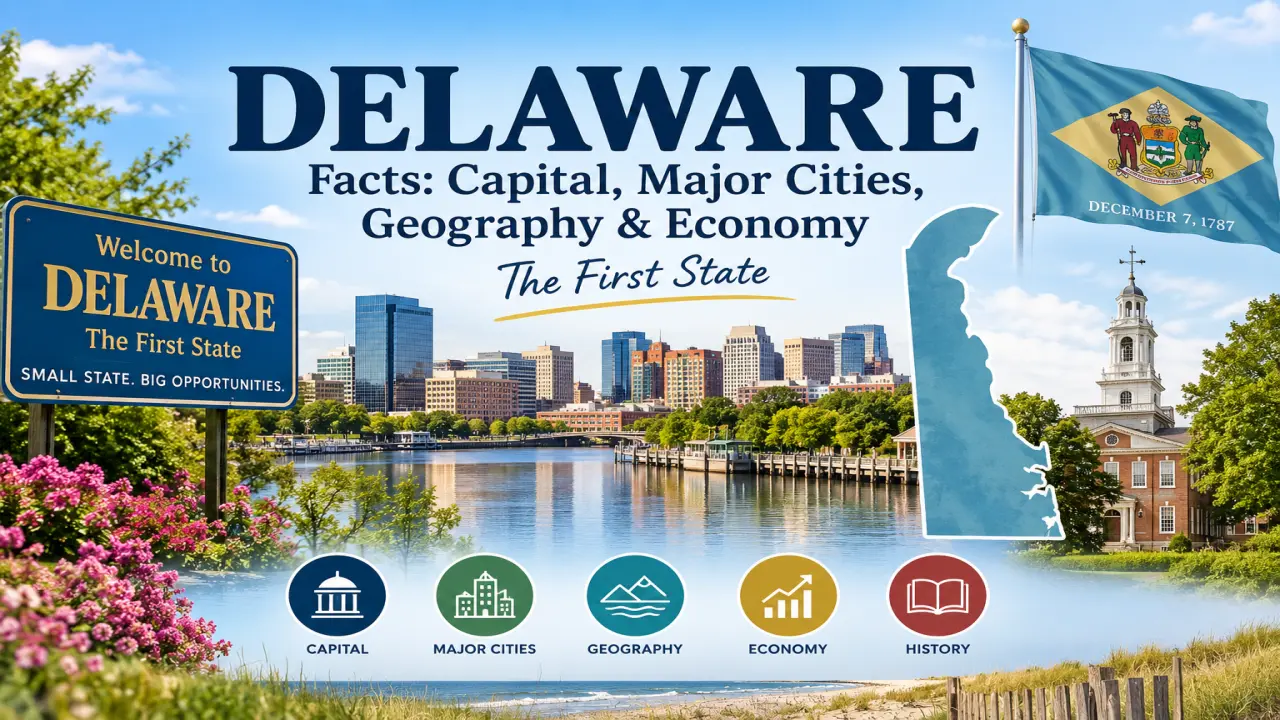
Delaware sits on the eastern edge of the United States between the large cities of the Northeast and the farms, wetlands, bays, and beaches of the Delmarva Peninsula. It is the second-smallest U.S. state by area, yet it has played an unusually large role in American history, corporate law, banking, and finance.

Dover is Delaware’s capital, while Wilmington is its largest city and main financial center. Most of the state is low and flat, with the Atlantic Coastal Plain covering central and southern Delaware and a small stretch of hillier Piedmont terrain in the north.

Delaware is best known as “The First State” because it became the first of the original 13 states to ratify the U.S. Constitution, doing so on December 7, 1787. Today, the state is also known for its business-law system, banking and financial services, poultry farming, Atlantic beaches, and steadily growing population.

Quick Facts About Delaware

FactDelaware
Official nameState of Delaware
Postal abbreviationDE
CapitalDover
Largest cityWilmington
RegionMid-Atlantic
NicknameThe First State
MottoLiberty and Independence
U.S. Constitution ratifiedDecember 7, 1787
Statehood order1st
Land areaAbout 1,949 square miles
Population1,059,952 — July 1, 2025 estimate
Counties3
Counties by nameNew Castle, Kent, and Sussex
Highest pointEbright Azimuth
Highest elevationAbout 448 feet above sea level
Lowest elevationSea level
State birdBlue Hen chicken
State flowerPeach blossom
State treeAmerican holly
State colorsColonial blue and buff
State song“Our Delaware”
Time zoneEastern Time
Major bodies of waterDelaware River, Delaware Bay, Atlantic Ocean

The U.S. Census Bureau lists Delaware’s 2020 land area at 1,948.55 square miles. The state is about 96 miles from north to south and ranges from roughly 9 to 35 miles wide.

Continue reading “Delaware Facts: Capital, Major Cities, Geography & Economy”
Colorado Facts: Capital, Major Cities, Geography & Economy

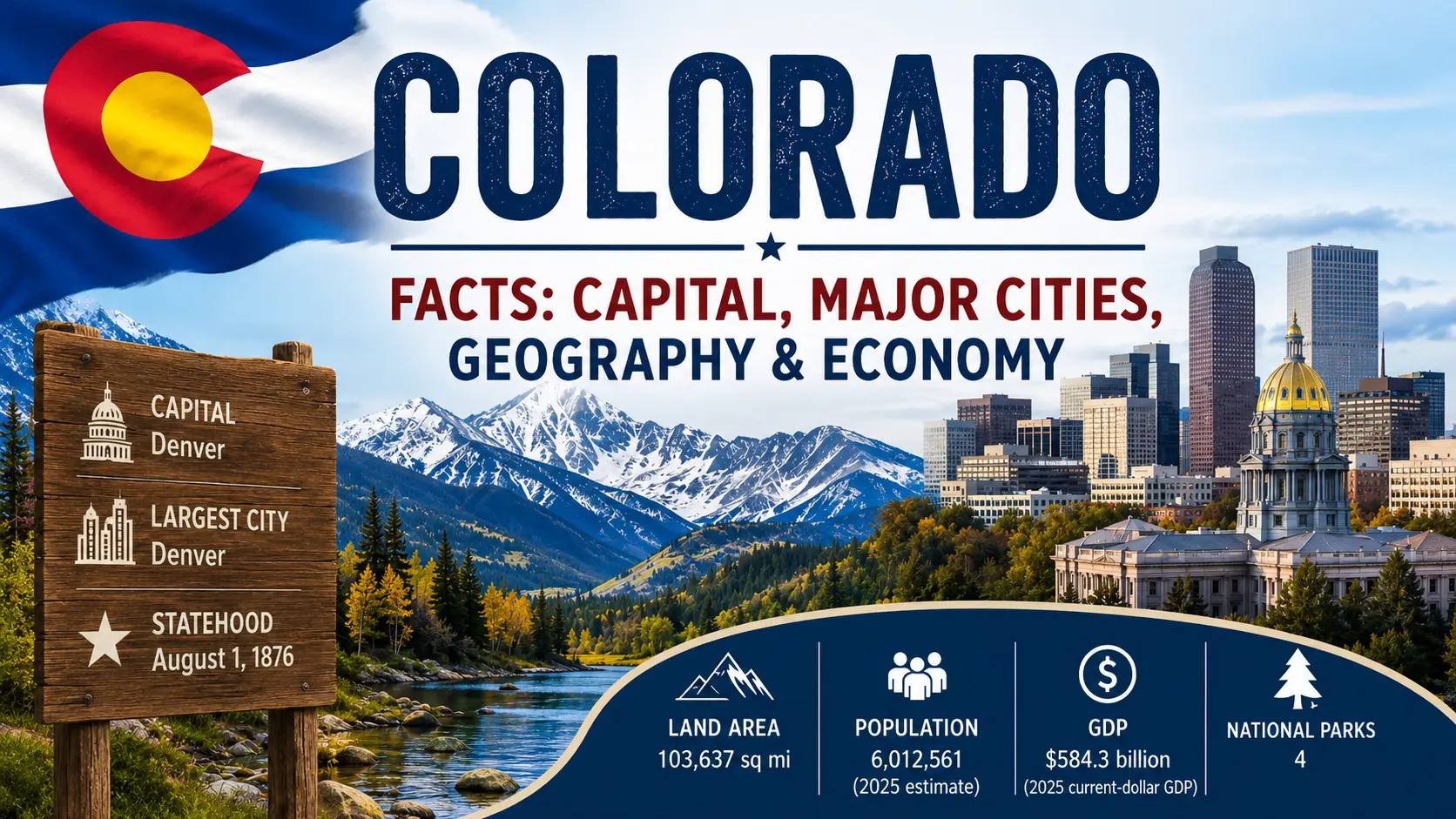
Colorado is a state of striking contrasts. Snow-covered Rocky Mountain peaks rise above broad valleys, while the eastern third of the state opens onto the Great Plains. Denver is a major city and transportation center, yet large parts of western Colorado are made up of mountains, forests, canyons, plateaus, and small communities.

Those landscapes have shaped Colorado’s history and its economy. Mining helped bring waves of newcomers in the nineteenth century. Farming and ranching remain important, especially on the plains and in western valleys. Today, technology, aerospace, tourism, energy, healthcare, finance, manufacturing, agriculture, and federal research all have substantial roles in the state.

This guide covers the essential facts about Colorado, including its capital, major cities, geography, population, economy, GDP, history, national parks, landmarks, and state symbols.

Continue reading “Colorado Facts: Capital, Major Cities, Geography & Economy”
Arkansas Facts: Capital, Major Cities, Geography & Economy

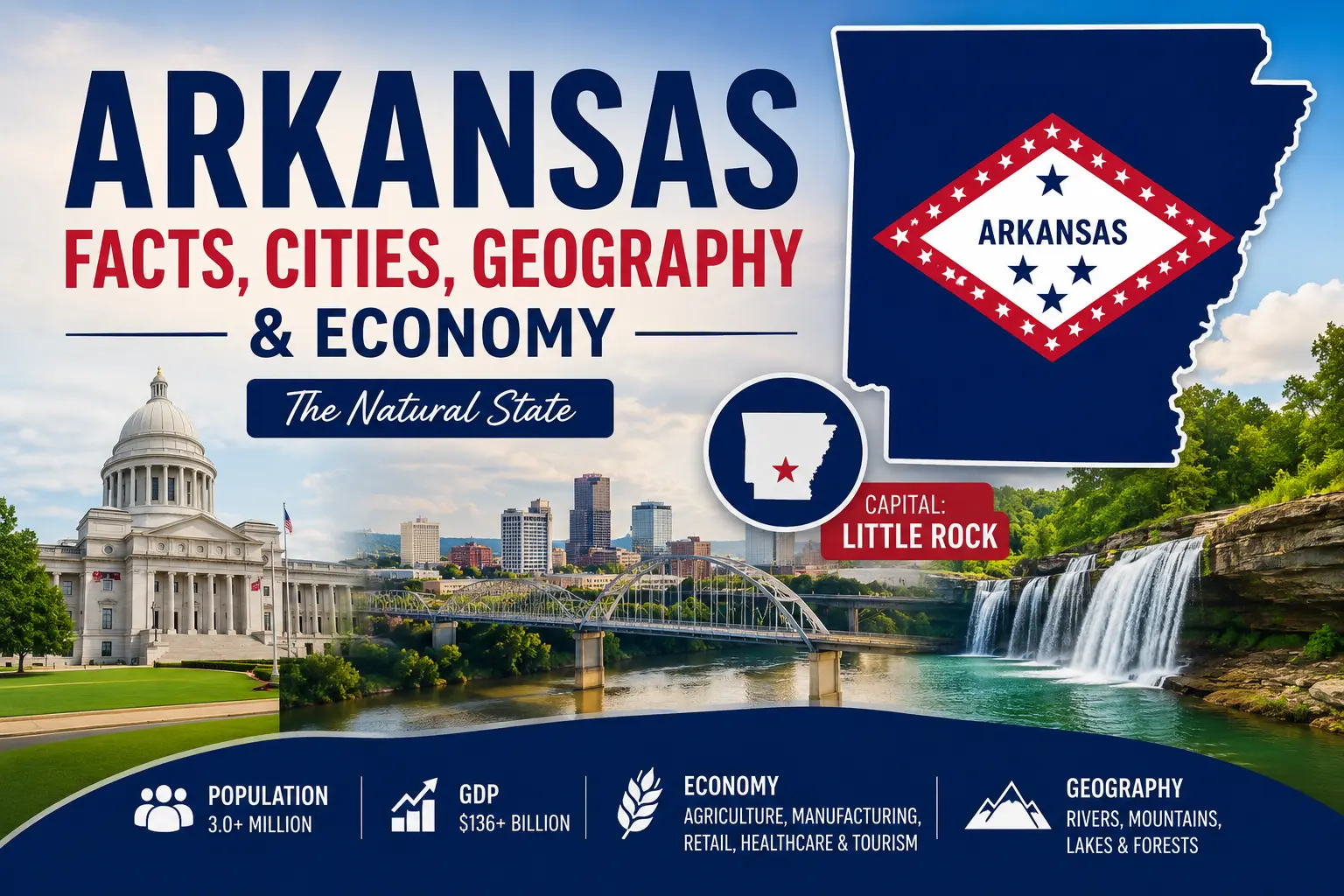
Arkansas is a state where mountain country, broad river valleys, forests, farmland, and fast-growing cities all meet. Located in the south-central United States, it stretches from the Ozark and Ouachita mountains to the flat, fertile lands along the Mississippi River. Little Rock is both the state capital and its largest city, while Northwest Arkansas has become one of the state’s busiest centers for population growth, education, retail, food production, and transportation.

Arkansas is also deeply tied to American history. It entered the Union in 1836, played an important role in the Civil War, and later became the setting for one of the defining school-desegregation struggles of the Civil Rights Movement. Today, the state’s economy mixes agriculture and manufacturing with retail, logistics, healthcare, tourism, and other services.

This guide covers the most useful Arkansas facts, including its capital, major cities, geography, population, economy, GDP, history, landmarks, state symbols, and facts students are likely to encounter in school or general-knowledge quizzes.

Continue reading “Arkansas Facts: Capital, Major Cities, Geography & Economy”
Alaska Facts: Capital, Major Cities, Geography, Economy & History

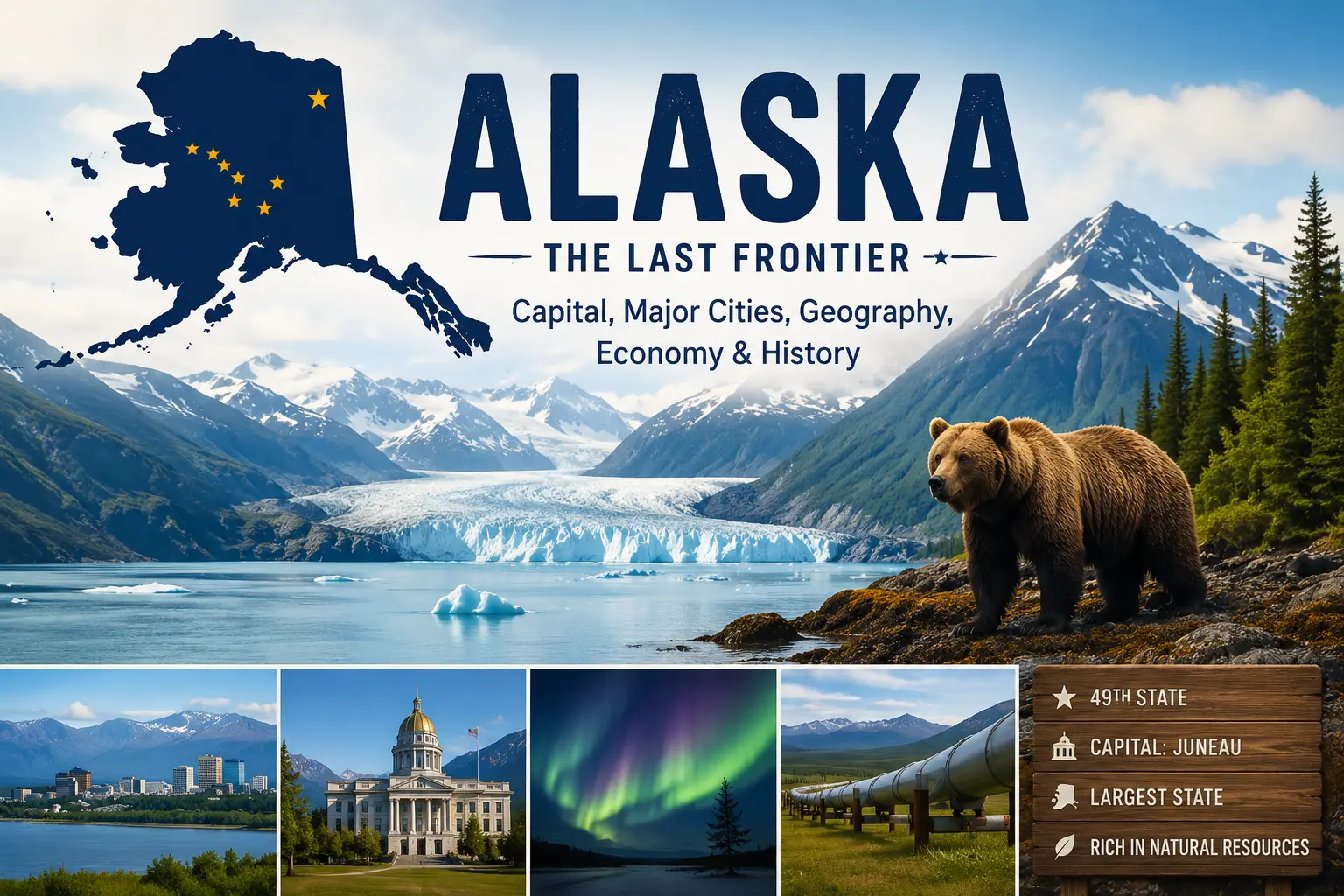
Alaska is unlike any other U.S. state. It is enormous, sparsely populated, and filled with mountains, glaciers, forests, tundra, rivers, islands, and long stretches of coastline. It sits at the far northwestern edge of North America, separated from the lower 48 states by Canada.

Juneau is the capital of Alaska, while Anchorage is the largest city and home to the biggest share of the state’s population. Alaska is also known for its Alaska Native cultures, oil fields, fishing industry, national parks, wildlife, and North America’s highest mountain.

In this guide, you’ll learn the most important facts about Alaska, including its geography, cities, population, history, economy, GDP, natural resources, landmarks, and state symbols.

Data last reviewed: August 2026. Population figures are based on the latest available U.S. Census Bureau estimates, and GDP figures come from the U.S. Bureau of Economic Analysis.

Continue reading “Alaska Facts: Capital, Major Cities, Geography, Economy & History”

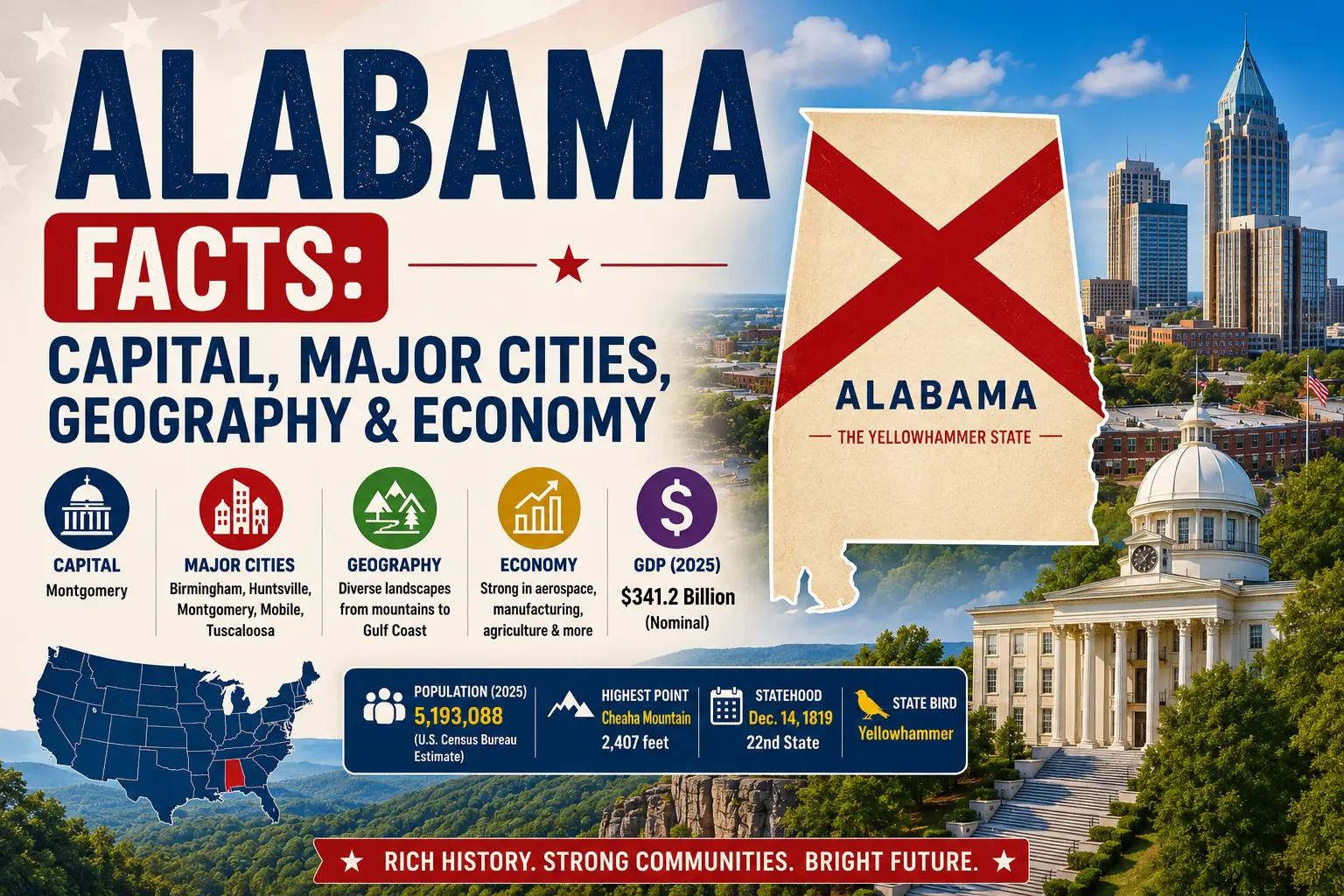
Alabama Facts: Capital, Major Cities, Geography & Economy

Alabama is a state in the Southeastern United States with a landscape that stretches from Appalachian ridges and river valleys in the north to forests, fertile plains, Mobile Bay, and the Gulf Coast in the south. Its capital is Montgomery, while Huntsville is the state’s largest city by the U.S. Census Bureau’s July 1, 2025 population estimate. Alabama is also important to U.S. history because of its Indigenous heritage, cotton and industrial history, major role in the Civil Rights Movement, and modern contributions to aerospace, automotive manufacturing, defense, agriculture, and international trade.

This guide covers essential Alabama facts, including the state’s capital, major cities, population, geography, economy, GDP, history, landmarks, state symbols, and facts students should know.

Data last reviewed: August 2026
Population data: U.S. Census Bureau
Economic and GDP data: U.S. Bureau of Economic Analysis and other cited government sources

Continue reading “Alabama Facts: Capital, Major Cities, Geography & Economy”
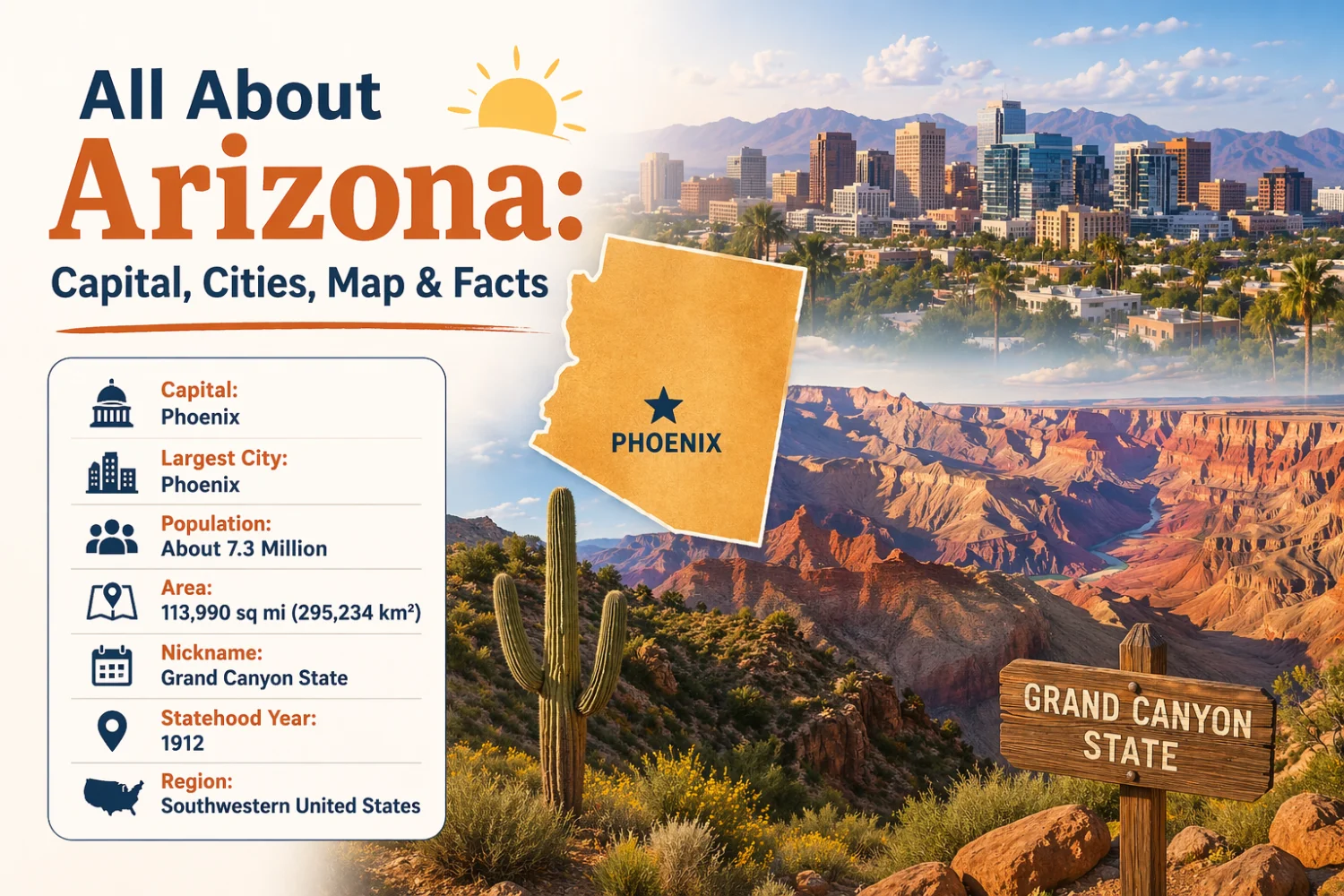
All About Arizona: Capital, Cities, Map & Facts

Quick Facts about Arizona

  • Capital city: Phoenix
  • Largest City: Phoenix
  • Population: About 7.3 million (estimate)
  • Area: 113,990 sq mi (295,234 km²)
  • Nickname: Grand Canyon State
  • Statehood Year: 1912
  • Region: Southwestern United States

Introduction

Arizona is a U.S. state in the southwestern region known for its dramatic desert landscapes, high plateaus and the Grand Canyon. The state combines significant Native American history, rapid urban growth in its lowland valleys, and extensive federally managed public lands. Arizona’s economy relies on sectors such as mining, manufacturing, tourism and technology, while its environments range from hot Sonoran Desert basins to snow-covered mountain peaks.

Location of Arizona

Arizona is located in the southwestern United States. It occupies part of the country’s western interior and extends to the international border with Mexico.

The state borders California to the west, Nevada to the northwest, Utah to the north, Colorado at a single point in the northeast (the Four Corners), and New Mexico to the east. To the south it shares an international border with the Mexican state of Sonora.

Continue reading “All About Arizona: Capital, Cities, Map & Facts”