





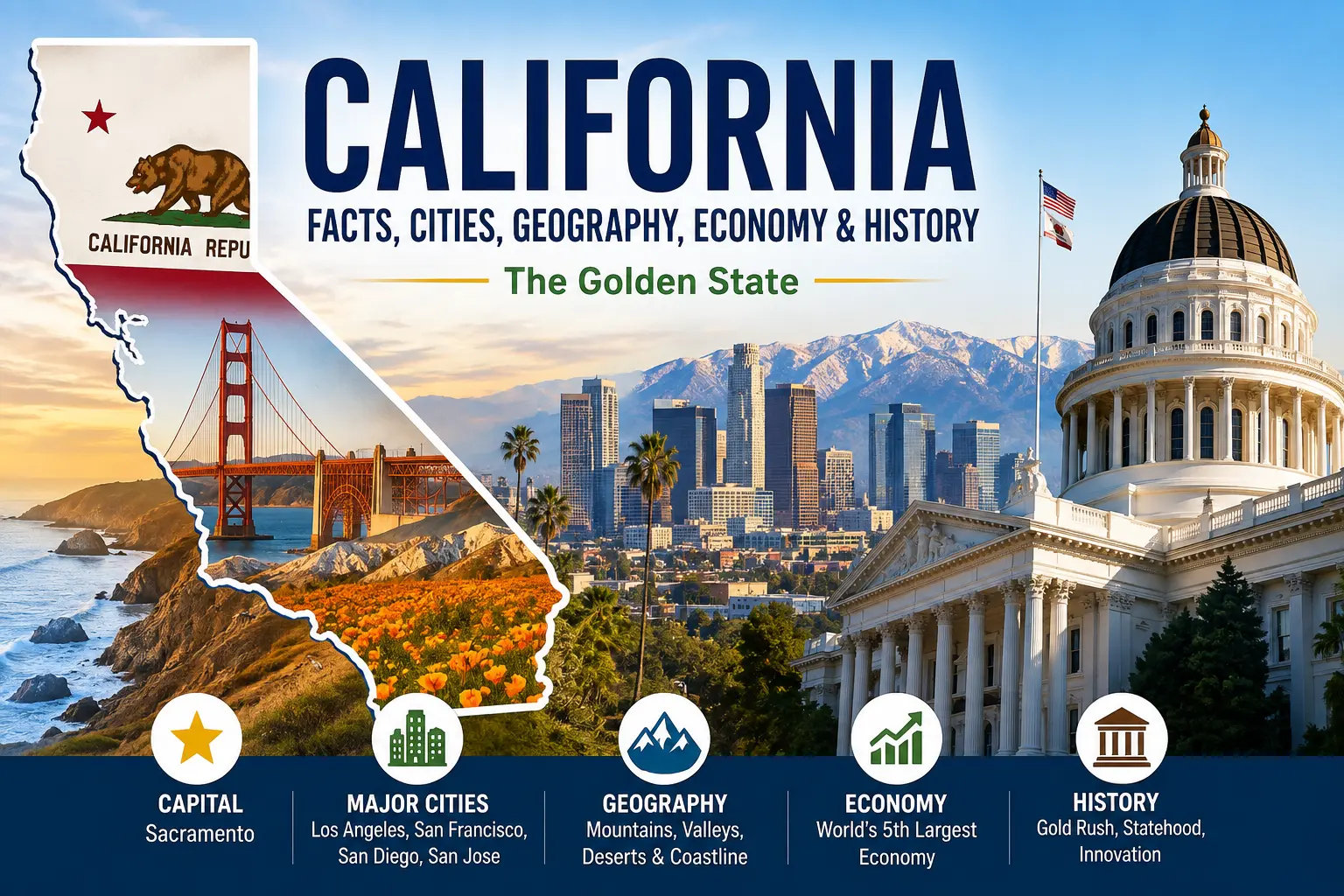
California is a state of contrasts. Snow-covered mountains rise above dry deserts, rich farmland stretches through the Central Valley, and a long Pacific coastline connects major cities with some of the busiest trade routes in the world. It is home to Hollywood, Silicon Valley, Yosemite, Death Valley, giant redwoods, productive farms, major universities, and nearly 40 million people.
California is also one of the most important states in the United States by population and economic output. Sacramento is the state capital, while Los Angeles is its largest city. California’s economy reaches far beyond entertainment and technology: agriculture, manufacturing, international trade, tourism, professional services, life sciences, transportation, and many other industries all play major roles.
This guide covers the essential facts about California, including its capital, major cities, geography, population, economy, GDP, history, landmarks, state symbols, and useful facts for students.
Quick Facts About California
| Fact | California |
|---|---|
| Official name | State of California |
| Postal abbreviation | CA |
| Capital | Sacramento |
| Largest city | Los Angeles |
| Region | Western United States |
| Statehood | September 9, 1850 |
| Statehood order | 31st state |
| Nickname | The Golden State |
| Population | 39,355,309 (July 1, 2025 estimate) |
| Total area | About 163,695 square miles |
| Land area | 155,858.33 square miles |
| Area rank | 3rd largest U.S. state |
| Counties | 58 |
| Highest point | Mount Whitney |
| Lowest point | Death Valley |
| State flower | California poppy |
| State bird | California quail |
| State animal | California grizzly bear |
| State tree | California redwood |
| Major rivers | Sacramento, San Joaquin, Colorado |
| Time zone | Pacific Time |
Where Is California Located?
California is on the western edge of the United States, facing the Pacific Ocean. It stretches from Oregon in the north to Mexico in the south and includes coastal areas, fertile valleys, high mountains, forests, and deserts.
California on the U.S. Map
California is usually grouped with the Pacific states of the western United States. Its location has shaped much of its history and economy. The Pacific gives California direct access to trade with Asia and other parts of the world, while mountain ranges, deserts, and river valleys have influenced where people live, farm, build cities, and travel.
What States Border California?
California borders three U.S. states. Oregon lies to the north, Nevada forms much of the eastern border, and Arizona meets California in the southeast. The Colorado River forms part of the California-Arizona boundary.
California also shares an international border with Mexico. Baja California, a Mexican state, lies directly south of California. The San Diego-Tijuana area is one of the most important cross-border urban regions in North America.
How Large Is California?
California covers about 163,695 square miles in total area, making it the third-largest U.S. state after Alaska and Texas. The U.S. Census Bureau reports 155,858.33 square miles of land area.
Its large size is one reason California cannot be described by a single landscape or climate. A person traveling from the far north to the Mexican border can pass through redwood forests, farmland, major metropolitan areas, mountain passes, Mediterranean-type landscapes, and desert.
Geography of California
California has some of the most varied geography in the United States. Its landscape includes a long Pacific coast, the Central Valley, the Sierra Nevada, the Coast Ranges, volcanic areas, high desert, and some of the hottest and driest land in North America.
Major Geographic Regions of California
Along the Pacific are coastal plains, cliffs, beaches, bays, and the Coast Ranges. Farther inland lies the Central Valley, one of the state’s most important agricultural regions. East of the valley rises the Sierra Nevada, a high mountain range that includes Mount Whitney and famous landscapes such as Yosemite.
Northern California also includes parts of the Cascade Range and volcanic landscapes around Mount Shasta and Lassen Peak. In southeastern California, the terrain becomes much drier, with the Mojave and Colorado deserts covering large areas.
California Coastline
The Pacific Ocean is central to California’s identity. Coastal California includes major cities such as San Diego, Los Angeles, and San Francisco, as well as fishing communities, ports, beaches, rocky cliffs, wetlands, and protected natural areas.
The coast has also played an important economic role. California’s natural harbors and ports helped connect the state with domestic and international markets, while beaches and coastal scenery helped make tourism a major industry.
The Central Valley
The Central Valley runs through the interior of California between the Coast Ranges and the Sierra Nevada. Its northern portion is commonly called the Sacramento Valley, while the southern portion is the San Joaquin Valley.
The valley contains some of the country’s most productive farmland. Fertile soils, a long growing season, irrigation systems, and large farming operations support crops ranging from fruits and vegetables to almonds, pistachios, grapes, and tomatoes.
Mountains of California
The Sierra Nevada is California’s best-known mountain range. It forms a dramatic wall along the eastern side of the Central Valley and contains high peaks, alpine lakes, forests, and deep valleys.
Mount Whitney, in the Sierra Nevada, is California’s highest point and the highest summit in the contiguous United States. The U.S. Geological Survey lists its elevation at about 14,494 feet. Other important mountain areas include the Coast Ranges, the southern California ranges, and the Cascade Range in the north.
Deserts and Death Valley
California is not only beaches and forests. Large parts of southeastern California are desert. The Mojave Desert includes Death Valley, one of the hottest places on Earth.
Death Valley also contains California’s lowest point. Badwater Basin lies about 282 feet below sea level. The contrast is remarkable: the highest point in the contiguous United States and the country’s lowest land elevation are both found in California and are separated by a relatively short distance.
Rivers and Lakes
The Sacramento and San Joaquin rivers form the heart of California’s largest river system. Their waters support cities, farms, wetlands, and ecosystems before meeting in the Sacramento-San Joaquin Delta and flowing toward San Francisco Bay.
The Colorado River is also important, particularly to southeastern California and Southern California’s water supply. Major lakes and inland waters include Lake Tahoe, which California shares with Nevada, and the Salton Sea in the southeastern part of the state.
Climate of California
California has several climate zones rather than one statewide climate. Much of the populated coast has mild, wet winters and dry summers. Interior valleys usually experience hotter summers, while mountain areas receive cold winters and heavy snow at high elevations. Desert regions can become extremely hot and receive very little rain.
This climate diversity affects farming, water use, energy demand, tourism, wildfire conditions, and even the kinds of homes and infrastructure built in different parts of the state.
Natural Hazards in California
Earthquakes are closely associated with California because the state lies along the boundary between major tectonic plates. The San Andreas Fault is the best-known fault system, but it is only one of many active faults in the state.
Wildfires are another serious hazard, especially during dry and windy periods. California also faces droughts, floods, landslides, coastal erosion, and extreme heat. These hazards are not evenly distributed, so the risks faced by a mountain community can be very different from those of a coastal city or desert town.
What Is the Capital of California?
Sacramento is the capital of California. It is located in the northern part of the Central Valley near the meeting of the Sacramento and American rivers.
Sacramento is the seat of California’s state government and home to the State Capitol. Government is an important part of the city’s economy, but Sacramento is also a transportation, health care, education, and business center for the surrounding region.
Why Is Sacramento the Capital of California?
California did not begin with Sacramento as its permanent capital. In the state’s early years, lawmakers met in several places, including San Jose, Vallejo, and Benicia. Political disagreements and inadequate facilities led to repeated moves.
Sacramento eventually provided a more practical location and became the permanent center of state government. Its importance had already grown rapidly during the Gold Rush because of its position near the mining regions and along important river and transportation routes.
Is Sacramento the Largest City in California?
No. Sacramento is California’s capital, but Los Angeles is the state’s largest city. This is a useful distinction to remember: a state capital is the seat of state government, while the largest city is determined by population.
Major Cities in California
California has several major urban regions, each with a different economic and cultural role. Los Angeles dominates Southern California, San Diego anchors the state’s southern border region, San Jose sits at the heart of Silicon Valley, and San Francisco is a major center of the Bay Area. Sacramento serves as the state capital, while Fresno is one of the main cities of the Central Valley.
| City | 2025 population estimate | Known for |
|---|---|---|
| Los Angeles | 3,869,089 | Entertainment, trade, business, culture |
| San Diego | 1,406,106 | Defense, tourism, biotechnology, border economy |
| San Jose | 989,814 | Silicon Valley and technology |
| San Francisco | 826,079 | Finance, technology, tourism, culture |
| Fresno | 555,549 | Agriculture and Central Valley commerce |
| Sacramento | 536,449 | State government and regional services |
Population figures are U.S. Census Bureau estimates for July 1, 2025.
Los Angeles
Los Angeles is California’s largest city and one of the largest cities in the United States. It is famous for Hollywood, but its economy is much broader than film and television. International trade, manufacturing, professional services, fashion, tourism, technology, music, and transportation all contribute to the wider Los Angeles economy.
San Diego
San Diego lies near the Mexican border and has strong economic ties to both the Pacific and the cross-border region. The city is known for its military presence, defense industries, biotechnology, research, tourism, beaches, and large natural harbor.
San Jose and Silicon Valley
San Jose is the largest city in Northern California by population and sits within Silicon Valley. The surrounding area became a global center for semiconductors, computers, software, internet businesses, venture capital, and more recently artificial intelligence and other advanced technologies.
San Francisco
San Francisco occupies a peninsula between the Pacific Ocean and San Francisco Bay. The city grew rapidly during the Gold Rush and later developed into a major center for finance, shipping, tourism, technology, and culture. The Golden Gate Bridge is one of its best-known landmarks.
Fresno and Sacramento
Fresno is a major city in the San Joaquin Valley and is closely connected with the agricultural economy of the Central Valley. Sacramento, farther north, combines its role as the state capital with health care, education, transportation, and regional business activity.
Population of California
The U.S. Census Bureau estimated California’s population at 39,355,309 on July 1, 2025. That makes California the most populous state in the United States, ahead of Texas and Florida.
California’s population is not spread evenly across the state. Large concentrations live in the Los Angeles region, the San Francisco Bay Area, San Diego County, the Sacramento region, and the growing cities of the Central Valley. Large mountain and desert areas remain much more lightly populated.
Is California’s Population Still Growing?
California’s recent population story is more complicated than the rapid growth that characterized much of the 20th century. According to the Census Bureau’s current estimate series, the July 2025 population was about 0.5% below the state’s April 2020 population-estimate base.
Population change can result from several forces at once, including births, deaths, people moving between states, and international migration. Trends also differ by region: some inland communities can grow even while certain coastal cities lose population.
Economy of California
California has the largest state economy in the United States. Its strength comes from diversity rather than one industry. Technology may dominate headlines, and Hollywood is famous around the world, but California also has huge agricultural, manufacturing, trade, health care, professional-service, tourism, transportation, construction, and government sectors.
Geography helps explain some of this economic variety. Fertile valleys support farming, Pacific ports support international trade, major universities support research and new companies, and large metropolitan areas create enormous markets for services, construction, entertainment, and consumer goods.
California GDP
Gross domestic product, or GDP, measures the value of goods and services produced within an economy. It is one way to measure the overall size of California’s economy.
According to U.S. Bureau of Economic Analysis data, California’s current-dollar GDP was about $4.25 trillion in 2025. That was the largest GDP of any U.S. state.
BEA’s first-quarter 2026 data placed California’s current-dollar GDP at a seasonally adjusted annual rate of about $4.40 trillion. That figure should not be confused with a completed full-year total. An annual rate takes the pace of economic activity during a quarter and expresses it as if that pace continued for a year.
GDP Is Not the Same as Income
GDP is sometimes misunderstood. A $4.25 trillion state GDP does not mean California’s government collects $4.25 trillion, nor does it mean that amount is divided among residents. GDP measures economic production. Government revenue, household income, wages, company profits, and personal income are different measures.
Major Industries in California
California’s economy includes technology and information services, finance and real estate, professional and business services, health care, manufacturing, entertainment, agriculture, construction, transportation, tourism, education, and government.
The mix varies sharply by region. Silicon Valley is closely associated with technology. Los Angeles has entertainment, trade, manufacturing, fashion, and services. San Diego has defense, tourism, life sciences, and cross-border commerce. The Central Valley is heavily tied to farming, food processing, logistics, and growing inland cities.
Technology and Silicon Valley
Silicon Valley is not an official city or county. The name refers to a technology-centered region in and around the Santa Clara Valley and the southern San Francisco Bay Area, including San Jose and nearby communities.
The region first became famous for electronics and semiconductor companies. It later became a center for personal computing, software, internet businesses, smartphones, cloud computing, biotechnology, venture capital, and artificial intelligence.
Research universities, skilled workers, investors, established technology companies, and networks of new businesses helped create an environment where new ideas could move quickly from laboratories and small companies into global markets.
Hollywood and California’s Entertainment Industry
Hollywood, a neighborhood of Los Angeles, became closely identified with the American film industry during the early 20th century. Southern California offered varied scenery, favorable weather for outdoor filming, a growing labor force, and room for studios to expand.
Today, California remains an important center for film, television, music, animation, streaming media, production technology, advertising, and related creative work. The entertainment industry also supports tourism and many businesses that supply equipment, sets, visual effects, costumes, catering, transportation, and professional services.
Agriculture in California
California is the leading agricultural state in the United States by farm cash receipts. According to the California Department of Food and Agriculture, farms and ranches received about $61.2 billion for their output in 2024.
The state’s agricultural variety is remarkable. California produces more than 400 commodities. Dairy products, almonds, grapes, cattle, lettuce, strawberries, pistachios, tomatoes, carrots, and poultry were among its highest-value agricultural products in 2024.
Much of this production is concentrated in the Central Valley and other irrigated farming regions. Water is therefore one of California agriculture’s most important economic and environmental issues. Farms depend on a combination of reservoirs, rivers, canals, groundwater, snowmelt, and local water systems.
International Trade and California’s Ports
California’s Pacific location makes the state a major gateway for international trade. The Ports of Los Angeles and Long Beach form the San Pedro Bay port complex, one of the world’s busiest container-port regions.
The Port of Los Angeles alone handled about 10.2 million twenty-foot equivalent container units, or TEUs, in 2025. Goods arriving through Southern California ports move across the country by truck and rail, while American products leave through the same trade network.
Ports support far more than jobs on the waterfront. Warehouses, railroads, trucking companies, customs services, distribution centers, retailers, manufacturers, and other businesses depend on the flow of goods through California.
Tourism in California
California attracts visitors for many different reasons. Some come for Los Angeles and Hollywood, others for San Francisco, San Diego, beaches, theme parks, wine regions, mountains, deserts, or national parks.
The state’s geographic variety allows very different kinds of travel within the same state. A visitor can explore giant sequoias, ski in the Sierra Nevada, walk through a desert landscape, visit a Pacific beach, tour a movie studio, or cross the Golden Gate Bridge.
Brief History of California
California’s history did not begin with the Gold Rush. Indigenous peoples had lived throughout the region for thousands of years before Europeans arrived. The state’s later history passed through Spanish and Mexican rule before California became part of the United States.
Indigenous Peoples of California
Before European colonization, California was home to hundreds of Indigenous communities with distinct languages, governments, economies, traditions, and relationships with the land. California State Parks estimates that more than 300,000 Indigenous people lived in the region before European settlement.
Communities adapted to very different environments, from the North Coast redwood forests and Central Valley grasslands to deserts, mountains, islands, and coastal areas. Fishing, hunting, gathering, controlled burning, trade, plant management, and highly developed craft traditions supported life across these regions.
Colonization brought devastating changes. Disease, violence, forced labor, mission policies, displacement, land loss, and later waves of settlement caused severe population and cultural losses. California’s Native peoples did not disappear, however. Tribal nations and Native communities remain an important part of California today and continue to protect languages, traditions, cultural sites, and sovereign rights.
Spanish California
Spanish exploration of the California coast began centuries before permanent colonization. In 1769, Spain began establishing missions, presidios, and settlements in Alta California. A chain of 21 missions eventually stretched along much of the coast.
The mission system changed Native life dramatically. Indigenous people supplied much of the labor that supported missions and nearby settlements, while disease and coercive colonial policies caused enormous suffering.
California Under Mexican Rule
Mexico gained independence from Spain in 1821, and California became part of the new Mexican nation. During the Mexican period, mission lands were secularized and large ranchos became important parts of the regional economy. Cattle ranching and the hide-and-tallow trade played major roles.
California Becomes Part of the United States
The Mexican-American War changed California’s political future. U.S. forces took control of California during the conflict, and the Treaty of Guadalupe Hidalgo ended the war in 1848. Mexico transferred a vast territory to the United States, including present-day California.
The California Gold Rush
On January 24, 1848, James Marshall found gold while working at John Sutter’s sawmill on the South Fork of the American River. News spread slowly at first, but by 1849 fortune seekers were arriving from across the United States and around the world. They became known as the Forty-Niners.
The Gold Rush transformed California at extraordinary speed. Mining camps appeared, businesses grew, transportation routes expanded, and San Francisco became a booming port city. California State Parks notes that the non-Indigenous population rose from about 14,000 around the time gold was discovered to nearly 100,000 by the end of 1849.
The Gold Rush also had destructive effects. Mining damaged rivers and landscapes, while the rapid arrival of miners and settlers intensified violence, dispossession, and loss of resources for Native communities.
California Becomes the 31st State
California became the 31st state on September 9, 1850. It entered the Union as a free state through the political settlement known as the Compromise of 1850.
Statehood came unusually quickly. California had experienced a huge population increase during the Gold Rush, creating an urgent need for formal government and representation.
Railroads, Farming, and Growing Cities
After the Gold Rush, California continued to grow. The completion of the first transcontinental railroad in 1869 connected the state more directly with the rest of the country. Agriculture expanded as irrigation projects brought water to dry but fertile land, and ports connected California products with national and international markets.
Los Angeles, San Francisco, Sacramento, San Diego, and other cities grew through migration, commerce, industry, and transportation. California’s population became increasingly diverse as people arrived from other U.S. states and from countries around the world.
California in the 20th Century
During the 20th century, California became a center for oil production, agriculture, film, aviation, military industries, shipping, higher education, and suburban growth. Hollywood turned Southern California into a global entertainment center, while World War II accelerated shipbuilding and aircraft production.
After the war, population growth, highways, universities, defense research, electronics companies, and new housing reshaped the state. The technology industry that emerged around the San Francisco Bay Area eventually produced Silicon Valley.
Government of California
California’s state government is based in Sacramento and follows the familiar three-branch structure: executive, legislative, and judicial.
The California Legislature has two chambers: the State Assembly and the State Senate. California is also known for its use of ballot initiatives, referendums, and recalls, which allow voters to participate directly in certain state policy decisions.
California is divided into 58 counties. Cities, counties, school districts, and special districts handle many local public services alongside state and federal agencies.
Education and Research in California
California has one of the largest higher-education systems in the country. Public higher education includes the University of California, California State University, and California Community Colleges systems.
Well-known institutions include the University of California, Berkeley; the University of California, Los Angeles; Stanford University; and the California Institute of Technology. Universities and research centers contribute to fields such as engineering, medicine, agriculture, computing, space science, climate research, biotechnology, and artificial intelligence.
The connection between universities and industry is especially visible in technology and life sciences. Research can lead to new companies, while businesses fund research, recruit graduates, and work with university laboratories.
Famous Landmarks and Natural Attractions in California
Yosemite National Park
Yosemite is famous for its granite cliffs, waterfalls, giant sequoias, mountain scenery, and Yosemite Valley. Landmarks such as El Capitan and Half Dome are recognized around the world.
Sequoia and Kings Canyon
These parks protect parts of the Sierra Nevada and groves of giant sequoias, the largest trees on Earth by volume. The General Sherman Tree in Sequoia National Park is one of the most famous examples.
Death Valley
Death Valley is known for extreme heat, desert scenery, salt flats, mountains, sand dunes, and Badwater Basin, the lowest land point in the United States.
Redwood Forests
Northern California protects some of the tallest trees on Earth: coast redwoods. Farther inland and south in the Sierra Nevada, giant sequoias grow to enormous trunk volumes.
Golden Gate Bridge
The Golden Gate Bridge connects San Francisco with Marin County across the Golden Gate strait. Completed in 1937, it became one of California’s most recognizable human-made landmarks.
Big Sur
Big Sur is a dramatic stretch of California’s central coast where mountains rise sharply from the Pacific. Its cliffs, forests, ocean views, and winding coastal highway have made it one of the state’s best-known scenic regions.
Hollywood and Disneyland
Hollywood represents California’s long connection with movies and television. Disneyland, which opened in Anaheim in 1955, became another internationally recognized California attraction and helped strengthen Southern California’s tourism industry.
California State Symbols
| Symbol | Official California symbol |
|---|---|
| Nickname | The Golden State |
| Motto | Eureka |
| State animal | California grizzly bear |
| State bird | California quail |
| State flower | California poppy |
| State tree | California redwood |
| State freshwater fish | Golden trout |
| State marine mammal | California gray whale |
| State gemstone | Benitoite |
The California grizzly bear is an interesting symbol because grizzlies no longer live wild in the state. The animal remains prominent on California’s flag and represents an important part of the state’s historical identity.
Why Is California Called the Golden State?
California’s official nickname is “The Golden State.” The Gold Rush is the most obvious connection, but the nickname has wider associations. California was linked with images of gold even before the 1848 discovery, and the state’s golden poppies and dry summer hills also fit the name.
“The Golden State” had been used informally for many years before California made it its official state nickname in 1968.
Interesting Facts About California
- California became the 31st U.S. state on September 9, 1850.
- Sacramento is the capital, but Los Angeles is the largest city.
- California is the most populous state in the United States.
- It is the third-largest U.S. state by total area, behind Alaska and Texas.
- California borders Oregon, Nevada, Arizona, Mexico, and the Pacific Ocean.
- Mount Whitney is the highest point in the contiguous United States.
- Death Valley contains the lowest land elevation in the United States.
- Gold was discovered at Sutter’s Mill in January 1848, helping trigger the California Gold Rush.
- California’s Central Valley is one of the most productive agricultural regions in the country.
- Silicon Valley became one of the world’s leading centers for technology and venture capital.
- Hollywood made Southern California a global center for film and television.
- California has both coast redwoods, the world’s tallest trees, and giant sequoias, which include some of the world’s largest trees by volume.
- The state contains climates ranging from snowy alpine environments to extremely hot desert.
- California has 58 counties.
- The name “California” can be traced to a fictional island described in an early Spanish romance.
California Facts for Students
If you are studying California for a geography, history, economics, or general knowledge test, these are the facts worth remembering first.
| Capital | Sacramento |
| Largest city | Los Angeles |
| Abbreviation | CA |
| Nickname | The Golden State |
| Statehood | September 9, 1850 |
| State number | 31st |
| Region | Western United States |
| Ocean | Pacific Ocean |
| Highest point | Mount Whitney |
| Major agricultural region | Central Valley |
| Major technology region | Silicon Valley |
| Famous entertainment center | Hollywood |
| Important historical event | California Gold Rush |
California Facts Quizzes
What is the official name of California?
What is California’s postal abbreviation?
Which city is the capital of California?
Which city is the largest in California?
In which part of the United States is California located?
Which ocean lies along California’s western coast?
Which state borders California to the north?
Which state borders much of California to the east?
Which state borders California to the southeast?
Which country shares an international border with California?
Read more quizzes on California Facts
Frequently Asked Questions About California
What is California best known for?
California is known for its Pacific coastline, Hollywood, Silicon Valley, major cities, agriculture, the Gold Rush, national parks, beaches, giant redwoods and sequoias, and its large and diverse economy. It is also the most populous U.S. state.
What is the capital of California?
Sacramento is the capital of California. It became the permanent center of state government after California’s government met in several different cities during the state’s early years.
What is the largest city in California?
Los Angeles is California’s largest city. The U.S. Census Bureau estimated its population at 3,869,089 on July 1, 2025.
What are the major cities in California?
Major California cities include Los Angeles, San Diego, San Jose, San Francisco, Fresno, Sacramento, Long Beach, Oakland, Bakersfield, and Anaheim. Different cities serve different roles in technology, government, trade, agriculture, tourism, manufacturing, and entertainment.
What is the population of California?
California had an estimated population of 39,355,309 on July 1, 2025, according to the U.S. Census Bureau. It remains the most populous state in the United States.
Why is California called the Golden State?
The nickname is strongly associated with California’s Gold Rush, but it also fits the state’s golden poppies and golden-colored summer hills. “The Golden State” became California’s official nickname in 1968.
What are California’s major industries?
California’s major industries include technology, professional services, entertainment, agriculture, manufacturing, health care, finance and real estate, tourism, construction, international trade, transportation, life sciences, aerospace, and government.
What is California’s GDP?
California’s current-dollar GDP was about $4.25 trillion in 2025, according to the U.S. Bureau of Economic Analysis. BEA’s first-quarter 2026 estimate was running at a seasonally adjusted annual rate of about $4.40 trillion.
What states border California?
California shares borders with Oregon, Nevada, and Arizona. It also borders Mexico to the south and the Pacific Ocean to the west.
When did California become a state?
California became the 31st state of the United States on September 9, 1850. Its admission came during the rapid changes brought by the Gold Rush and as part of the Compromise of 1850.
What is the highest point in California?
Mount Whitney in the Sierra Nevada is California’s highest point. At roughly 14,500 feet above sea level, it is also the highest summit in the contiguous United States.
Why is California important to the U.S. economy?
California matters to the national economy because of both its size and its range of industries. The state is a major center for technology, agriculture, entertainment, trade, manufacturing, tourism, research, finance, transportation, and professional services. Its ports also connect U.S. businesses and consumers with international markets.
What to Remember About California
California is much more than Hollywood, beaches, and Silicon Valley. Its geography ranges from fertile valleys and redwood forests to high mountains and desert basins. That landscape helped shape where Californians built cities, how farmers used the land, where transportation routes developed, and how the state’s economy grew.
Its history is equally varied. Indigenous societies lived across California for thousands of years before Spanish colonization. The region later became part of Mexico, passed to U.S. control after the Mexican-American War, experienced the enormous changes of the Gold Rush, and entered the Union as the 31st state in 1850.
Today, Sacramento serves as the state capital, Los Angeles is the largest city, and California remains the most populous state in the country. With an economy measured in trillions of dollars, globally important technology and entertainment industries, productive farms, major ports, universities, and extraordinary natural landscapes, California continues to play an unusually large role in the United States.
Sources and Data Notes
Population and city population estimates in this article use U.S. Census Bureau data. GDP figures use U.S. Bureau of Economic Analysis data. Agricultural figures come from the California Department of Food and Agriculture. Geographic elevations are based on U.S. Geological Survey information. Historical facts were checked against California State Parks and the National Park Service.
Data last reviewed: August 2026. Population, GDP, agricultural production, and other changing statistics should be checked periodically as new official data are released.