


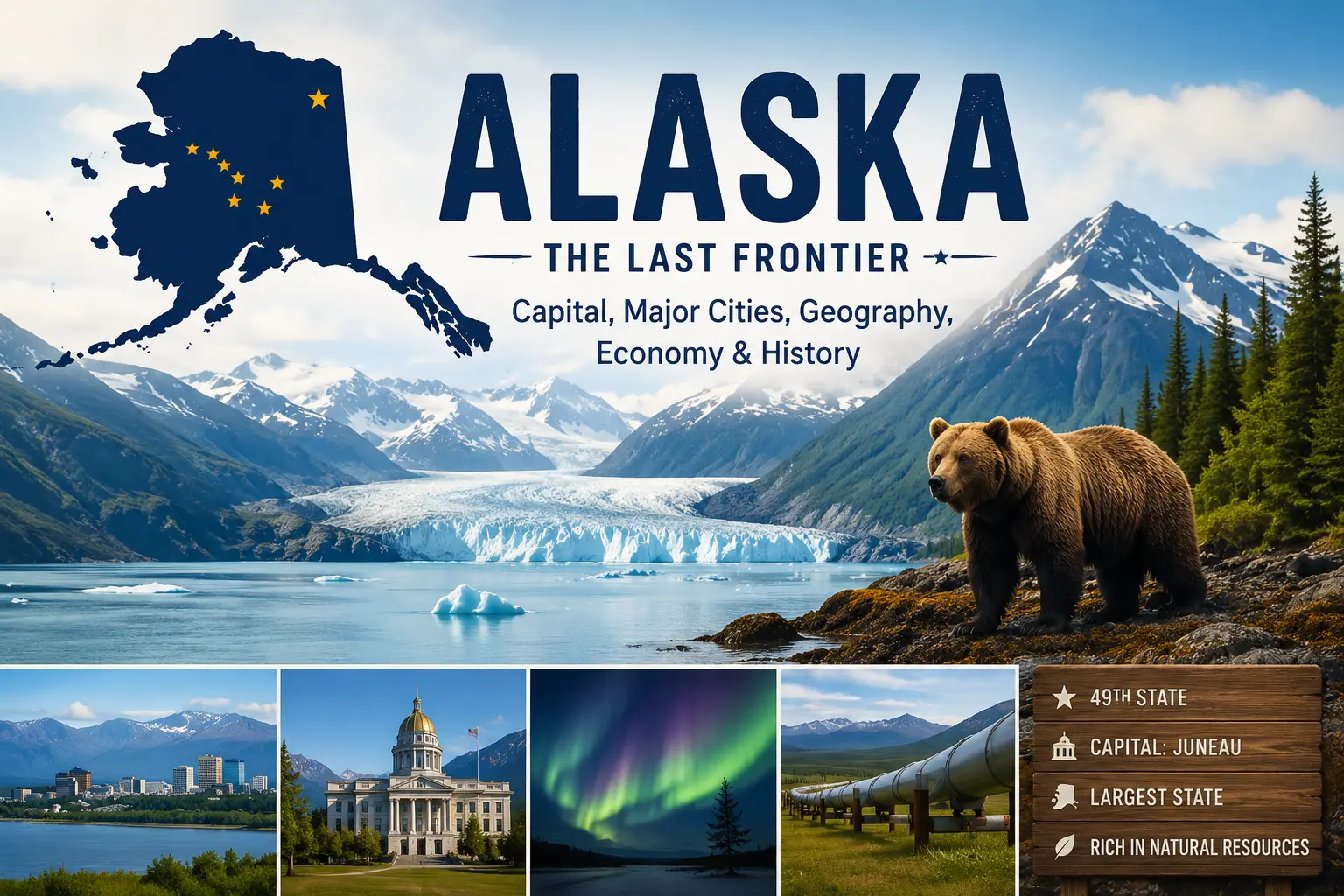
Alaska is unlike any other U.S. state. It is enormous, sparsely populated, and filled with mountains, glaciers, forests, tundra, rivers, islands, and long stretches of coastline. It sits at the far northwestern edge of North America, separated from the lower 48 states by Canada.
Juneau is the capital of Alaska, while Anchorage is the largest city and home to the biggest share of the state’s population. Alaska is also known for its Alaska Native cultures, oil fields, fishing industry, national parks, wildlife, and North America’s highest mountain.
In this guide, you’ll learn the most important facts about Alaska, including its geography, cities, population, history, economy, GDP, natural resources, landmarks, and state symbols.
Data last reviewed: August 2026. Population figures are based on the latest available U.S. Census Bureau estimates, and GDP figures come from the U.S. Bureau of Economic Analysis.
Quick Facts About Alaska
| Fact | Alaska |
| Official name | State of Alaska |
| Postal abbreviation | AK |
| Capital | Juneau |
| Largest city | Anchorage |
| Nickname | The Last Frontier |
| State motto | North to the Future |
| Statehood date | January 3, 1959 |
| Order of statehood | 49th state |
| 2025 population estimate | 737,270 |
| Land area | 571,022.38 square miles |
| 2020 population density | 1.3 people per square mile |
| Highest point | Mount McKinley, widely known as Denali — 20,310 feet |
| Neighboring country | Canada |
| Major bodies of water | Arctic Ocean, Pacific Ocean, Bering Sea, Gulf of Alaska |
| State bird | Willow ptarmigan |
| State flower | Forget-me-not |
| State tree | Sitka spruce |
| State fish | King salmon |
Where Is Alaska Located?
Alaska is in the far northwest of North America. Canada lies to the east, the Arctic Ocean lies to the north, and the Pacific Ocean and Gulf of Alaska lie to the south. The Bering Sea is to the west and southwest.
Unlike the other 48 contiguous states, Alaska does not share a border with another U.S. state. To travel overland between Alaska and the lower 48 states, you must pass through Canada.
Alaska on the Map of North America
Alaska stretches across a huge part of northwestern North America. Its mainland reaches north into the Arctic, while the Alaska Peninsula and Aleutian Islands extend far west into the North Pacific.
The state’s location also gives it an important place in Arctic research, aviation, fishing, shipping, national defense, and relations across the northern Pacific.
What Borders Alaska?
Canada is the only country that shares a land border with Alaska. Alaska borders Canada’s Yukon territory and the province of British Columbia.
Russia lies to the west across the Bering Strait. Although Alaska and Russia are close to each other, they do not share a land border.
How Large Is Alaska?
Alaska is the largest state in the United States by area. The U.S. Census Bureau lists 571,022.38 square miles of land area.
Its size is easy to underestimate because many maps place Alaska in a small inset beside the lower 48 states. In reality, Alaska is so large that communities within the state can be separated by hundreds of miles of mountains, rivers, wilderness, or ocean.
Geography of Alaska
Alaska has some of the most varied geography in the United States. Its landscape includes Arctic tundra, forests, mountain ranges, volcanoes, river valleys, glaciers, fjords, wetlands, islands, and long stretches of coastline.
Major Geographic Regions of Alaska
Alaska is often divided into several broad regions. Each one has its own climate, landscape, communities, and way of life.
- Arctic Alaska includes tundra, permafrost, coastal plains, and communities near or above the Arctic Circle.
- Interior Alaska includes large river valleys, forests, mountain ranges, and the city of Fairbanks.
- Southcentral Alaska includes Anchorage, the Matanuska-Susitna area, Prince William Sound, and the Kenai Peninsula.
- Southwest Alaska includes Bristol Bay, the Alaska Peninsula, Kodiak Island, the Yukon-Kuskokwim region, and the Aleutian Islands.
- Southeast Alaska includes Juneau, Sitka, Ketchikan, forested islands, fjords, and the Inside Passage.
Mountains of Alaska
Alaska has several major mountain ranges, including the Alaska Range, Brooks Range, Chugach Mountains, Wrangell Mountains, and Aleutian Range.
Many of Alaska’s mountains are covered by snow and ice for much of the year. Glaciers have also shaped valleys, fjords, and other landforms across large parts of the state.
Mount McKinley, Denali, and North America’s Highest Mountain
The highest mountain in Alaska is also the highest mountain in North America. It rises 20,310 feet above sea level in the Alaska Range.
The mountain is widely known as Denali, an Indigenous name with deep cultural meaning. In 2025, the U.S. federal government restored Mount McKinley as the official federal geographic name. The surrounding protected area is still called Denali National Park and Preserve.
Because both names are used today, students may see either Mount McKinley or Denali in books, maps, news reports, and government sources.
Glaciers and Icefields
Glaciers are one of Alaska’s most famous natural features. Large icefields feed glaciers that flow through mountain valleys and sometimes reach lakes, rivers, or the sea.
The Harding Icefield in Kenai Fjords National Park feeds dozens of glaciers. Other major glacier areas can be found around Glacier Bay, Prince William Sound, and the Juneau Icefield.
Major Rivers and Lakes
The Yukon River is one of Alaska’s best-known rivers. It crosses much of the Interior before flowing toward the Bering Sea. Other important rivers include the Kuskokwim, Copper, Susitna, Tanana, and Colville.
Rivers are especially important in Alaska because some communities have little or no road access. They support fish, transportation, local travel, and subsistence activities.
Coastline, Islands, and Volcanoes
Alaska has a long and complicated coastline filled with bays, fjords, islands, and peninsulas. The Aleutian Islands form a long chain stretching west from the Alaska Peninsula.
Many of the Aleutian Islands are volcanic. Alaska is one of the most volcanically active parts of the United States because it lies along an active plate boundary.
Climate of Alaska
Alaska does not have one single climate. Conditions vary greatly depending on location.
- Northern Alaska has an Arctic climate with long, cold winters and short, cool summers.
- Interior Alaska can have very cold winters and surprisingly warm summer days.
- Southeast Alaska has a milder, wetter maritime climate.
- Southcentral Alaska is influenced by both the ocean and inland weather systems.
Daylight also changes dramatically during the year. In the far north, the sun may stay above the horizon for weeks in summer and remain below it for a period in winter.
Natural Resources and Wildlife of Alaska
Alaska is home to vast forests, tundra, wetlands, rivers, mountains, and marine habitats. These environments support large numbers of wild animals and also provide food, jobs, and natural resources for Alaska communities.
Forests and Tundra
Much of Interior Alaska is covered by boreal forest, also called taiga. Farther north, the landscape changes into treeless Arctic tundra. Southeast Alaska, by contrast, contains wet coastal temperate rainforest.
Wildlife
Alaska is well known for brown bears, black bears, polar bears, moose, caribou, wolves, Dall sheep, bald eagles, sea otters, seals, walruses, and whales.
Its rivers and coastal waters also support salmon and many other fish species that are important to commercial fishing, local food supplies, and Alaska Native traditions.
What Is the Capital of Alaska?
Juneau is the capital of Alaska. It is in Southeast Alaska along the Inside Passage and is home to the main offices of the state government.
About Juneau
The City and Borough of Juneau had an estimated population of 31,609 on July 1, 2025. Government is a major part of the local economy, along with tourism, transportation, services, and fishing-related activity.
Juneau has one of the most unusual settings of any U.S. state capital. Mountains, icefields, and waterways surround the city.
Why Isn’t Anchorage the Capital?
Anchorage is much larger than Juneau, but a state’s largest city is not always its capital. Juneau became an important government center during Alaska’s territorial years and remained the capital when Alaska became a state in 1959.
The easiest way to remember the difference is simple: Juneau is the capital, and Anchorage is the largest city.
Can You Drive to Juneau?
No highway connects Juneau directly with the main North American road system. There are roads within the Juneau area, but travelers usually arrive by plane or ship. Ferry service is available through the Alaska Marine Highway System.
Major Cities in Alaska
Most Alaskans live in a relatively small number of cities and population centers. The figures below are U.S. Census Bureau estimates for July 1, 2025.
| City or municipality | 2025 estimated population | Known for |
|---|---|---|
| Anchorage | 287,155 | Largest city and main population center |
| Juneau | 31,609 | State capital |
| Fairbanks | 31,468 | Main center of Interior Alaska |
| Wasilla | 10,556 | Growing community in the Matanuska-Susitna area |
| Sitka | 8,319 | Historic coastal community |
| Ketchikan | 7,939 | Port, fishing, and tourism center |
Anchorage — Alaska’s Largest City
Anchorage is easily Alaska’s largest city. With an estimated population of 287,155 in 2025, it is home to a large share of the state’s residents.
The city is a major center for air travel, freight, health care, shopping, government, tourism, and business. Its airport and transportation links are especially important in a state where many communities are difficult to reach by road.
Fairbanks — Hub of Interior Alaska
Fairbanks is the main city of Interior Alaska. It is important for education, transportation, tourism, government, military activity, and services.
The University of Alaska Fairbanks is also well known for research on the Arctic, climate, geophysics, permafrost, and northern environments.
Population of Alaska
The U.S. Census Bureau estimated Alaska’s population at 737,270 on July 1, 2025. Alaska had 733,391 residents in the 2020 Census and 710,231 in the 2010 Census.
| Year | Population | Type |
|---|---|---|
| 2010 | 710,231 | Decennial Census |
| 2020 | 733,391 | Decennial Census |
| 2025 | 737,270 | July 1 population estimate |
Why Is Alaska So Sparsely Populated?
Alaska is huge, but relatively few people live there. In the 2020 Census, the state had only about 1.3 people per square mile of land.
There are several reasons. Much of Alaska has a cold or difficult climate, many areas are mountainous or remote, and some communities cannot be reached by road. Building roads, utilities, schools, and other services across such large distances can also be expensive.
As a result, people are concentrated around Anchorage, the Matanuska-Susitna area, Fairbanks, Juneau, and a number of smaller regional communities.
Alaska Native Peoples and Cultures
Alaska Native peoples have lived in the region for thousands of years. Their history is not a small part of Alaska’s story; it is where Alaska’s human history begins.
Alaska Native peoples are not one single cultural group. Alaska is home to many distinct peoples, including Iñupiat, Yup’ik and Cup’ik peoples, Unangax̂, Alutiiq/Sugpiaq peoples, Alaska Athabascan peoples, Tlingit, Haida, and Tsimshian communities.
Alaska Native Languages
The Alaska Native Language Center at the University of Alaska Fairbanks recognizes at least 20 Native languages in Alaska. These languages belong to several different language families.
Today, many communities, schools, elders, teachers, and language programs are working to preserve and teach Alaska Native languages.
Life Connected to Land and Sea
For generations, Alaska Native communities have relied on close knowledge of the land, rivers, sea, weather, animals, and seasons. Fishing, hunting, gathering, trade, and travel remain important parts of life in many communities.
These traditions are not only part of the past. They continue to shape food, family life, culture, and community ties across Alaska today.
History of Alaska
Alaska Before European Contact
Long before Europeans arrived, Indigenous peoples lived throughout Alaska in communities suited to very different environments. Some depended heavily on the sea, while others lived along rivers, in forests, on islands, or across Arctic tundra.
They developed trade networks, languages, technologies, art, social systems, and detailed knowledge of the natural world.
Russian Exploration and Russian America
Russian explorers and traders began expanding into Alaska during the 18th century. Sea otter fur was especially valuable, and the fur trade became a major reason for Russian activity in the region.
Russian settlements were established in some areas, but Russian influence was never equally strong across all of Alaska. The period brought trade and cultural exchange, but it also brought disease, violence, exploitation, and serious disruption to Alaska Native communities.
The Alaska Purchase of 1867
The United States purchased Alaska from Russia for $7.2 million in 1867. U.S. Secretary of State William H. Seward negotiated the deal with Russian representative Eduard de Stoeckl.
The agreement was reached on March 30, 1867, and the formal transfer took place on October 18 of the same year.
Some Americans mocked the purchase at the time. Later gold discoveries, fisheries, minerals, oil, and Alaska’s strategic location made the territory far more important than many early critics expected.
Gold Rush Era
Gold discoveries in Alaska and nearby Yukon brought large numbers of prospectors north in the late 1800s and early 1900s. Towns such as Skagway and Nome became closely linked with the gold-rush period.
Mining also encouraged new settlements, businesses, trails, ports, and transportation routes.
Alaska During World War II
Alaska became very important during World War II because of its location in the North Pacific.
Japanese forces occupied the islands of Attu and Kiska in 1942. The fighting that followed became the only major World War II ground campaign fought on incorporated U.S. territory in North America.
The war also led to more military bases, roads, airfields, and other construction in Alaska.
When Did Alaska Become a State?
Alaska became the 49th U.S. state on January 3, 1959.
Statehood gave Alaskans full representation as a state in Congress and established the modern state government under the Alaska Constitution.
Oil and the Trans-Alaska Pipeline
Large oil discoveries on Alaska’s North Slope changed the state’s economy. Prudhoe Bay became one of the best-known oil-producing areas in the United States.
The Trans-Alaska Pipeline System was built to carry crude oil from the North Slope south to Valdez, where it could be loaded onto ships.
Oil revenue later played an important role in the creation and growth of the Alaska Permanent Fund.
Economy of Alaska
Alaska’s economy is closely tied to its geography and natural resources. Oil is important, but it is only one part of the state’s economy.
Other major parts of the economy include government, transportation, fishing, seafood processing, mining, tourism, health care, construction, retail, and military activity.
Oil and Gas
Oil and gas have played a major role in Alaska since large-scale production began on the North Slope. Petroleum supports jobs, businesses, transportation, and state revenue.
The Trans-Alaska Pipeline remains one of the clearest symbols of Alaska’s oil industry.
Fishing and Seafood
Fishing is another major part of Alaska’s economy. Salmon, pollock, crab, halibut, cod, and other species support commercial fleets, seafood plants, ports, and coastal communities.
Fishing also matters outside the commercial industry. Many Alaska families depend on subsistence or personal-use fishing for food and tradition.
Mining
Mining has been part of Alaska’s economy for more than a century. Gold played a major role during the state’s early development, and modern mines also produce metals such as zinc and silver.
Because some mines are located in remote areas, even a single project can have a noticeable effect on nearby jobs and communities.
Tourism
Millions of visitors are drawn to Alaska’s glaciers, wildlife, national parks, cruises, fishing, mountains, and northern lights.
Tourism supports hotels, restaurants, tour companies, guides, shops, transportation services, and seasonal jobs, especially in popular coastal and park areas.
Transportation and Logistics
Transportation matters more in Alaska than it does in many states because so many communities are far apart and not connected by road.
Aircraft carry passengers, mail, medical supplies, groceries, and freight. Ships and ferries serve coastal communities. Highways and the Alaska Railroad are important in areas where land routes are available.
Government and Military Activity
Federal, state, and local government jobs make up an important part of Alaska’s economy. The U.S. military also has a strong presence because Alaska is close to the Arctic and lies across the North Pacific from Russia.
GDP of Alaska
GDP, or gross domestic product, measures the total value of goods and services produced within an economy.
According to the U.S. Bureau of Economic Analysis, Alaska’s current-dollar GDP was about $75.0 billion in 2025.
For comparison, Alaska’s current-dollar GDP was about $71.6 billion in 2024 and $68.2 billion in 2023. These figures are measured in the dollars of each year and are not adjusted for inflation.
| Year | Alaska current-dollar GDP |
|---|---|
| 2023 | Approximately $68.2 billion |
| 2024 | Approximately $71.6 billion |
| 2025 | Approximately $75.0 billion |
What Industries Contribute to Alaska’s GDP?
Alaska’s GDP comes from many different activities. Government is a major contributor, as are mining and oil and gas extraction. Transportation is also especially important because of the state’s size and limited road system.
Health care, construction, real estate, retail, professional services, tourism, fishing, and other industries also add to Alaska’s economic output.
GDP Is Not the Same as Income
GDP does not tell us how much money the average person earns. It measures production across the whole economy.
Wages, household income, business profits, government payments, and cost of living are separate measures. That is why GDP should not be treated as the same thing as personal income.
The Alaska Permanent Fund
The Alaska Permanent Fund was created to save and invest part of the state’s mineral wealth for the future.
Alaska voters approved the fund through a constitutional amendment in 1976. Under the state constitution, at least 25 percent of certain mineral revenues must be placed into the fund.
The Alaska Permanent Fund Corporation manages the money and invests it over the long term.
What Is the Permanent Fund Dividend?
The Permanent Fund Dividend, usually called the PFD, is a yearly payment available to eligible Alaska residents.
The dividend is not the same thing as the Permanent Fund itself. The fund is the large pool of invested money, while the PFD is a payment program governed by state law.
The amount can change from year to year, so the Alaska Department of Revenue should be checked for the latest figure.
Government and Boroughs of Alaska
Why Doesn’t Alaska Have Counties?
Alaska does not use counties in the same way most U.S. states do. Instead, it uses boroughs.
Alaska currently has 19 organized borough governments. Areas outside those boroughs are part of the Unorganized Borough.
For Census purposes, parts of the Unorganized Borough are divided into census areas.
This unusual system makes more sense when Alaska’s geography is considered. Many communities are small, remote, and separated by huge distances.
Education in Alaska
The University of Alaska is the state’s main public university system. Its best-known campuses include the University of Alaska Anchorage, University of Alaska Fairbanks, and University of Alaska Southeast.
Education can be difficult to provide in remote parts of Alaska. Some villages are far from the road system and can be reached mainly by air, boat, or seasonal routes.
Arctic and Northern Research
Alaska is an important place for research on the Arctic and northern environments. Researchers study sea ice, climate, permafrost, earthquakes, volcanoes, fisheries, geophysics, Indigenous languages, and the challenges of building and living in cold regions.
National Parks and Famous Natural Places in Alaska
Alaska contains some of the largest protected wild areas in the United States. Its national parks preserve mountains, glaciers, tundra, volcanoes, rivers, wildlife habitat, and places of deep cultural importance.
| Place | Why it is important |
|---|---|
| Denali National Park and Preserve | Home to North America’s highest mountain and huge stretches of Interior wilderness |
| Glacier Bay National Park and Preserve | Known for glaciers, fjords, marine life, and Indigenous history |
| Kenai Fjords National Park | Known for coastal fjords and glaciers flowing from the Harding Icefield |
| Katmai National Park and Preserve | Famous for volcanoes and brown bears |
| Gates of the Arctic National Park and Preserve | Protects a vast roadless area north of the Arctic Circle |
| Wrangell-St. Elias National Park and Preserve | Known for huge mountains, glaciers, and wilderness |
Denali National Park and Preserve
Denali National Park and Preserve protects about six million acres of wild land in Interior Alaska. The landscape ranges from forests and tundra to glaciers and high mountains.
The park is also home to animals such as grizzly bears, caribou, moose, Dall sheep, and wolves.
Glacier Bay National Park and Preserve
Glacier Bay in Southeast Alaska is known for glaciers, fjords, mountains, marine wildlife, and its strong cultural ties to the Huna Tlingit.
It is a good example of how Alaska’s natural history and human history often overlap.
Famous Landmarks and Places in Alaska
- Mount McKinley/Denali — the highest mountain in North America.
- Trans-Alaska Pipeline System — carries crude oil from the North Slope to Valdez.
- Inside Passage — a network of waterways through Southeast Alaska.
- Aleutian Islands — a long chain of volcanic islands stretching west from the Alaska Peninsula.
- Prince William Sound — a coastal region known for islands, mountains, and glaciers.
- Mendenhall Glacier — a well-known glacier near Juneau.
- Arctic Circle — crosses northern Alaska.
- Dalton Highway — a remote highway leading north toward Alaska’s Arctic region.
Alaska State Symbols
| Symbol | Official designation |
|---|---|
| Nickname | The Last Frontier |
| Motto | North to the Future |
| State bird | Willow ptarmigan |
| State flower | Forget-me-not |
| State tree | Sitka spruce |
| State fish | King salmon |
| State land mammal | Moose |
| State marine mammal | Bowhead whale |
| State gem | Jade |
| State mineral | Gold |
| State sport | Dog mushing |
What Is Alaska Known For?
Alaska is best known for its huge size, mountains, glaciers, wildlife, Alaska Native cultures, national parks, oil fields, fisheries, and Arctic landscapes.
It is also famous for the northern lights, long summer days, remote communities, dog mushing, salmon fishing, and outdoor recreation.
In history, Alaska is closely linked with the Alaska Purchase, the gold rush, World War II in the Aleutian Islands, statehood in 1959, and the development of North Slope oil.
Interesting Facts About Alaska
- Alaska is the largest U.S. state by area.
- It became the 49th state on January 3, 1959.
- Juneau is the capital, but Anchorage is the largest city.
- Alaska does not share a land border with any other U.S. state.
- Canada is the only country that shares a land border with Alaska.
- The Bering Strait separates Alaska from Russia.
- Mount McKinley, widely known as Denali, is 20,310 feet high and is the tallest mountain in North America.
- Denali National Park and Preserve covers about six million acres.
- Alaska uses boroughs instead of the county system found in most states.
- Juneau is not connected to the continental highway system.
- The United States purchased Alaska from Russia for $7.2 million in 1867.
- Alaska belonged to the United States for more than 90 years before becoming a state.
- The Trans-Alaska Pipeline carries crude oil from the North Slope to Valdez.
- The Alaska Permanent Fund was created in 1976.
- Alaska is home to many distinct Alaska Native peoples and at least 20 Native languages.
- The Aleutian Islands form a long volcanic chain.
- Parts of Alaska lie north of the Arctic Circle.
- Some northern communities experience continuous daylight in summer and periods without sunrise in winter.
- Fishing and seafood processing are major parts of Alaska’s economy.
- Alaska has one of the lowest population densities in the United States.
Alaska Facts for Students
If you are studying Alaska for school, an exam, or a quiz, these are the facts worth remembering:
- Capital: Juneau
- Largest city: Anchorage
- Postal abbreviation: AK
- Nickname: The Last Frontier
- Motto: North to the Future
- Statehood date: January 3, 1959
- Statehood order: 49th
- 2025 population estimate: 737,270
- Largest state distinction: Largest U.S. state by area
- Highest point: Mount McKinley/Denali, 20,310 feet
- Neighboring country: Canada
- Major river: Yukon River
- Major industries: Government, oil and gas, transportation, fishing, mining, tourism, and services
- Important historical event: Alaska Purchase from Russia in 1867
- Major infrastructure: Trans-Alaska Pipeline System
Alaska MCQ Quiz Questions and Answers
1. What is the capital of Alaska?
- A. Anchorage
- B. Fairbanks
- C. Juneau
- D. Sitka
Answer: C. Juneau
2. What is the largest city in Alaska?
- A. Fairbanks
- B. Anchorage
- C. Juneau
- D. Ketchikan
Answer: B. Anchorage
3. When did Alaska become a U.S. state?
- A. 1867
- B. 1912
- C. 1945
- D. 1959
Answer: D. 1959
4. Alaska was which state admitted to the Union?
- A. 47th
- B. 48th
- C. 49th
- D. 50th
Answer: C. 49th
5. From which country did the United States purchase Alaska?
- A. Canada
- B. Russia
- C. France
- D. Spain
Answer: B. Russia
6. How much did the United States agree to pay for Alaska in 1867?
- A. $2.5 million
- B. $5 million
- C. $7.2 million
- D. $12 million
Answer: C. $7.2 million
7. What is the highest mountain in Alaska and North America?
- A. Mount Rainier
- B. Mount Whitney
- C. Mount Foraker
- D. Mount McKinley/Denali
Answer: D. Mount McKinley/Denali
8. Which country shares Alaska’s land border?
- A. Russia
- B. Canada
- C. Mexico
- D. Greenland
Answer: B. Canada
9. What is Alaska’s postal abbreviation?
- A. AL
- B. AS
- C. AK
- D. AR
Answer: C. AK
10. Which major river flows across Interior Alaska toward the Bering Sea?
- A. Colorado River
- B. Yukon River
- C. Hudson River
- D. Missouri River
Answer: B. Yukon River
11. What type of regional government does Alaska use instead of conventional counties?
- A. Provinces
- B. Parishes
- C. Districts
- D. Boroughs
Answer: D. Boroughs
12. Which Alaska industry is closely associated with the North Slope?
- A. Automobile manufacturing
- B. Oil and gas
- C. Cotton farming
- D. Semiconductor manufacturing
Answer: B. Oil and gas
13. What is Alaska’s nickname?
- A. The Sunshine State
- B. The Last Frontier
- C. The Empire State
- D. The Prairie State
Answer: B. The Last Frontier
14. What is the state bird of Alaska?
- A. Bald eagle
- B. Snowy owl
- C. Willow ptarmigan
- D. Raven
Answer: C. Willow ptarmigan
15. What is the Alaska Permanent Fund?
- A. A national park fund
- B. A university scholarship only
- C. A fund created to save and invest part of Alaska’s mineral wealth
- D. A federal transportation fund
Answer: C. A fund created to save and invest part of Alaska’s mineral wealth
Frequently Asked Questions About Alaska
What is the capital of Alaska?
Juneau is the capital of Alaska. It is in Southeast Alaska and is home to the main offices of the state government.
What is the largest city in Alaska?
Anchorage is Alaska’s largest city. The U.S. Census Bureau estimated its population at 287,155 on July 1, 2025.
What is Alaska known for?
Alaska is known for its huge size, mountains, glaciers, wildlife, Alaska Native cultures, oil fields, fisheries, national parks, and Arctic landscapes.
Why is Alaska part of the United States?
The United States purchased Alaska from Russia in 1867. Alaska later became a U.S. territory and then the 49th state in 1959.
When did the United States buy Alaska?
The United States and Russia agreed to the Alaska Purchase in March 1867. The formal transfer took place on October 18, 1867.
How much did the United States pay for Alaska?
The United States agreed to pay Russia $7.2 million for Alaska.
When did Alaska become a state?
Alaska became the 49th U.S. state on January 3, 1959.
What is the population of Alaska?
The U.S. Census Bureau estimated Alaska’s population at 737,270 on July 1, 2025.
What is Alaska’s GDP?
Alaska’s current-dollar GDP was about $75.0 billion in 2025, according to the U.S. Bureau of Economic Analysis.
What are Alaska’s major industries?
Major parts of Alaska’s economy include government, oil and gas, transportation, fishing and seafood processing, mining, health care, construction, tourism, and other services.
What country borders Alaska?
Canada is the only country that shares a land border with Alaska. Alaska borders Yukon and British Columbia.
Is Alaska close to Russia?
Yes. Alaska and Russia are separated by the Bering Strait, and the Diomede Islands lie between the two mainland areas.
What is the highest mountain in Alaska?
Mount McKinley, widely known as Denali, is Alaska’s highest mountain. It rises 20,310 feet and is also the highest mountain in North America.
Why doesn’t Alaska have counties?
Alaska uses boroughs instead of the county system used by most states. Areas outside organized boroughs are part of the Unorganized Borough and are divided into census areas for statistical purposes.
Is Juneau or Anchorage the capital of Alaska?
Juneau is the capital of Alaska. Anchorage is the state’s largest city, but it is not the capital.
Can you drive from the lower 48 states to Alaska?
Yes. You can drive to road-connected parts of Alaska from the contiguous United States by traveling through Canada.
Can you drive to Juneau?
No continuous highway connects Juneau with the main North American road system. Travelers usually reach the city by plane or ship.
Does Alaska have 24 hours of daylight?
Parts of northern Alaska have continuous daylight for a period during summer because they lie above the Arctic Circle. Those same areas can also go through a period without sunrise in winter. The amount of daylight depends on location and season, so this does not happen everywhere in Alaska at the same time.
Key Takeaways About Alaska
- Alaska is the largest U.S. state by area.
- Juneau is the capital, while Anchorage is the largest city.
- Alaska’s estimated population was 737,270 on July 1, 2025.
- Mount McKinley, widely known as Denali, rises 20,310 feet and is the highest mountain in North America.
- Alaska Native peoples have lived in the region for thousands of years and remain an important part of Alaska today.
- The United States purchased Alaska from Russia for $7.2 million in 1867.
- Alaska became the 49th state in 1959.
- Oil, government, transportation, fishing, mining, tourism, health care, and other services all contribute to the state’s economy.
- Alaska’s current-dollar GDP was about $75.0 billion in 2025.
- Alaska is famous for its mountains, glaciers, wildlife, national parks, Arctic landscapes, and remote communities.
Sources and References
- U.S. Census Bureau — Alaska population, land area, and city estimates.
- U.S. Bureau of Economic Analysis — Alaska GDP and state economic data.
- U.S. Department of State, Office of the Historian — Alaska Purchase.
- United States Senate — Alaska statehood history.
- National Park Service — Alaska national parks, Denali, glaciers, wildlife, and history.
- U.S. Department of the Interior — federal geographic naming information.
- State of Alaska — geography, state symbols, government, and educational information.
- Alaska Department of Commerce, Community, and Economic Development — boroughs and local government.
- Alaska Department of Transportation and Public Facilities — road and ferry information.
- Alaska Permanent Fund Corporation and Alaska Department of Revenue — Permanent Fund and PFD information.
- University of Alaska Fairbanks Alaska Native Language Center — Alaska Native languages.
Population, GDP, and other statistics can change when government agencies publish new estimates. When citing these figures, include the year so readers know exactly which data you are using.