



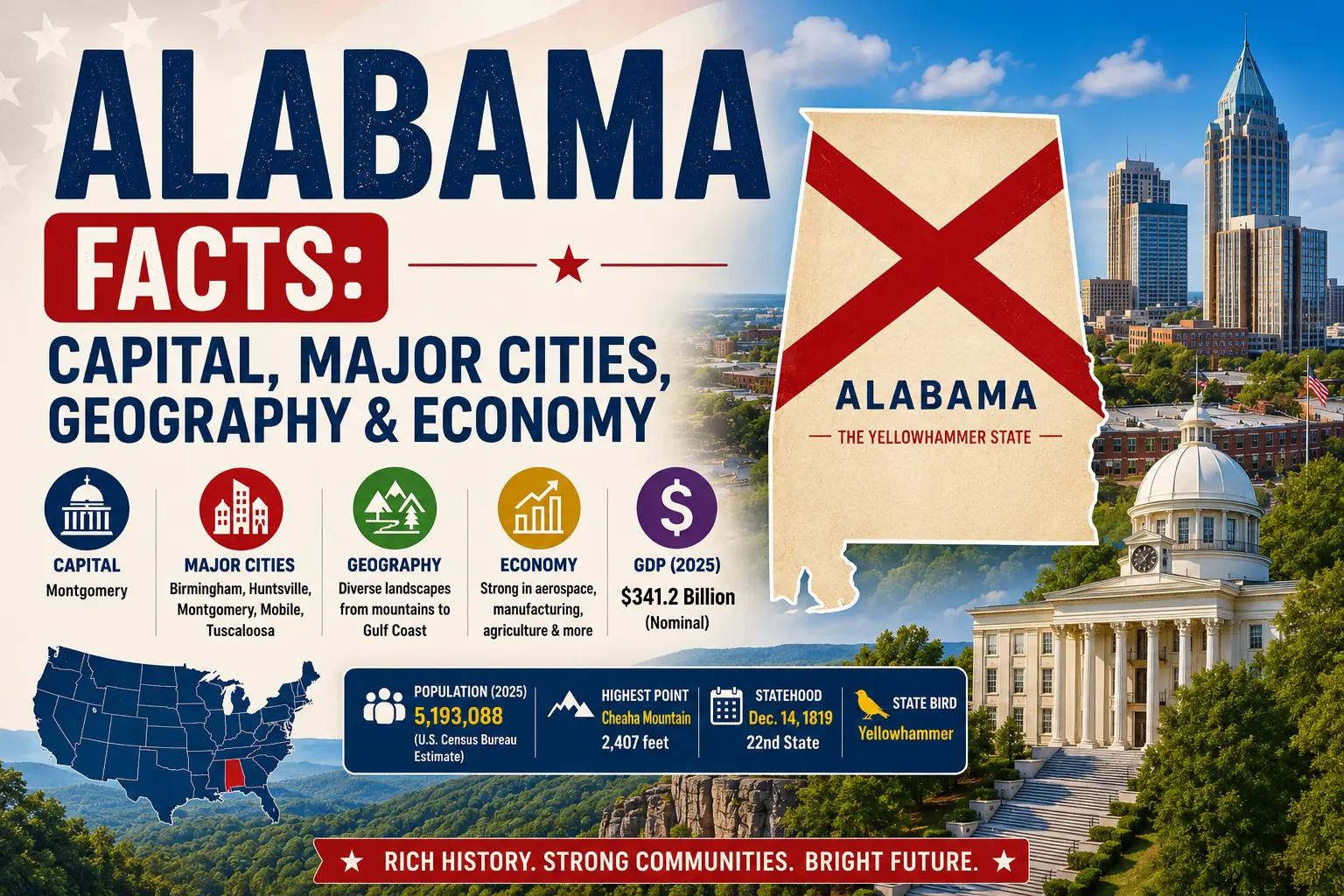
Alabama is a state in the Southeastern United States with a landscape that stretches from Appalachian ridges and river valleys in the north to forests, fertile plains, Mobile Bay, and the Gulf Coast in the south. Its capital is Montgomery, while Huntsville is the state’s largest city by the U.S. Census Bureau’s July 1, 2025 population estimate. Alabama is also important to U.S. history because of its Indigenous heritage, cotton and industrial history, major role in the Civil Rights Movement, and modern contributions to aerospace, automotive manufacturing, defense, agriculture, and international trade.
This guide covers essential Alabama facts, including the state’s capital, major cities, population, geography, economy, GDP, history, landmarks, state symbols, and facts students should know.
Data last reviewed: August 2026
Population data: U.S. Census Bureau
Economic and GDP data: U.S. Bureau of Economic Analysis and other cited government sources
Quick Facts About Alabama
| Fact | Alabama |
| Official name | State of Alabama |
| Postal abbreviation | AL |
| U.S. region | Southeast |
| Capital | Montgomery |
| Largest city | Huntsville |
| Statehood | December 14, 1819 |
| Order of statehood | 22nd state |
| Counties | 67 |
| Population | 5,193,088 (July 1, 2025 estimate) |
| Land area | 50,647.13 square miles |
| Population density | 99.2 people per square mile (2020) |
| Highest point | Cheaha Mountain — 2,407 feet |
| Lowest point | Gulf of Mexico — sea level |
| Nickname | Yellowhammer State |
| State bird | Yellowhammer |
| State flower | Camellia |
| State tree | Southern longleaf pine |
| State motto | Audemus jura nostra defendere — “We Dare Defend Our Rights” |
| Time zone | Central Time |
| FIPS code | 01 |
The U.S. Census Bureau estimates Alabama’s population at 5,193,088 as of July 1, 2025, up from its 2020 population level. The Census Bureau reports 50,647.13 square miles of land area, while the U.S. Geological Survey identifies Cheaha Mountain as Alabama’s highest point at 2,407 feet and the Gulf of Mexico as its lowest point at sea level.
Alabama became the 22nd state on December 14, 1819. The Yellowhammer, Camellia, and Southern longleaf pine are among the state’s best-known official symbols.
Where Is Alabama Located?
Alabama is located in the southeastern part of the United States. It borders Tennessee to the north, Georgia to the east, Florida and the Gulf of Mexico to the south, and Mississippi to the west.
Its location gives Alabama an unusually varied physical landscape. Northern Alabama belongs partly to the Appalachian system, while much of central and southern Alabama consists of lower and generally flatter terrain associated with the Gulf Coastal Plain.
Alabama’s Location in the United States
Alabama is generally considered part of both the Southeastern United States and the Deep South. Its location connects several important geographic areas.
- The Tennessee Valley in the north
- The Appalachian Highlands in the northeast
- Fertile central Alabama
- The coastal plain of southern Alabama
- Mobile Bay and the Gulf of Mexico
This location has strongly influenced Alabama’s agriculture, settlement patterns, transportation, industry, trade, and history.
What States Border Alabama?
Alabama shares land borders with four U.S. states:
- Tennessee — north
- Georgia — east
- Florida — southeast
- Mississippi — west
The state also reaches the Gulf of Mexico in the southwest, giving Alabama direct access to maritime trade through Mobile and Mobile Bay.
How Large Is Alabama?
The U.S. Census Bureau reports 50,647.13 square miles of land area for Alabama. Its long north-to-south shape helps explain why the state contains such different landscapes, from uplands and ridges to broad coastal plains.
Geography of Alabama
Alabama’s geography is much more diverse than its general image as a Deep South state might suggest. The state’s terrain reflects hundreds of millions of years of geological change, and its landscapes range from rugged uplands to low coastal areas.
Geographers commonly divide Alabama into five major physiographic sections:
- Highland Rim
- Cumberland Plateau
- Valley and Ridge
- Piedmont Upland
- East Gulf Coastal Plain
These regions differ in geology, elevation, soils, landforms, vegetation, and natural resources.
Highland Rim
The Highland Rim is found in northern Alabama. Limestone and other sedimentary rocks are common, and the Tennessee River is an important feature of the region.
The broader Tennessee Valley has long influenced settlement, agriculture, electricity generation, transportation, and industrial development in northern Alabama.
Cumberland Plateau
The Cumberland Plateau includes rugged areas of northern and northeastern Alabama. Sandstone ridges, valleys, bluffs, waterfalls, and gorges characterize parts of this landscape.
Bankhead National Forest provides a good example of the plateau environment, with steep gorges, streams, hardwood forests, and the Sipsey Wilderness.
Valley and Ridge
The Valley and Ridge section is part of the Appalachian Highlands. It consists of folded ridges and valleys running generally northeast to southwest.
The Coosa River is an important river system in this region. Alabama’s historic iron deposits, particularly around Birmingham’s Red Mountain, also helped shape the state’s industrial development.
Piedmont Upland
The Piedmont Upland lies primarily in east-central Alabama. It contains some of the state’s oldest rocks and more elevated terrain.
This is also the region containing Cheaha Mountain, Alabama’s highest natural point.
East Gulf Coastal Plain
The East Gulf Coastal Plain covers much of southern Alabama and extends into parts of central and northwestern Alabama. Its terrain is generally lower and less rugged than the Appalachian sections farther north.
The Coastal Plain includes agricultural lands, forests, river valleys, the Black Belt, Mobile Bay, and Alabama’s Gulf Coast.
What Is the Highest Point in Alabama?
Cheaha Mountain is the highest point in Alabama at 2,407 feet above sea level.
It is located in Cleburne County in east-central Alabama. Cheaha State Park surrounds the high point and is Alabama’s oldest state park, established in 1933. The mountain lies near the southern end of the Appalachian mountain system.
Alabama’s lowest elevation is sea level along the Gulf of Mexico.
Major Rivers and Waterways in Alabama
Water has played an important role in Alabama’s geography, settlement, agriculture, industry, electricity production, transportation, and biodiversity.
Important rivers and river systems include:
- Tennessee River
- Alabama River
- Coosa River
- Tallapoosa River
- Tombigbee River
- Black Warrior River
- Cahaba River
- Chattahoochee River
- Mobile River
The Coosa and Tallapoosa rivers join to form the Alabama River, while the Alabama and Tombigbee systems ultimately contribute to the Mobile River system and Mobile Bay.
The state’s extensive river network also helps explain Alabama’s exceptionally varied aquatic habitats.
The Alabama Black Belt
The Black Belt is one of Alabama’s most historically significant regions.
The name originally referred to the area’s dark, fertile soils, particularly those of the Blackland Prairie. These soils made central and west-central Alabama highly suitable for cotton cultivation during the nineteenth century.
The agricultural wealth created in the region depended heavily on the labor of enslaved African Americans. After emancipation, the Black Belt remained important to African American history, culture, agriculture, politics, and later the Civil Rights Movement.
The Alabama Black Belt should therefore be understood as both a physical geographic region and an important cultural-historical region.
Alabama’s Climate
Alabama has a generally humid subtropical climate, characterized by hot, humid summers and comparatively mild winters.
Northern portions of the state tend to experience cooler winter conditions than the Gulf Coast. Snow is possible, particularly in northern Alabama, but is relatively uncommon statewide.
Severe weather is also an important part of Alabama’s climate. Tornadoes can occur in multiple seasons, while southern Alabama can be affected by hurricanes and other tropical systems moving inland from the Gulf of Mexico.
What Is the Capital of Alabama?
Montgomery is the capital of Alabama.
Located in central Alabama along the Alabama River, Montgomery serves as the seat of Alabama’s state government. However, it was not Alabama’s first capital.
Why Is Montgomery the Capital of Alabama?
Alabama’s capital moved several times during the state’s early history. The Alabama Legislature selected Montgomery as the new capital in 1846, making it the state’s fifth capital city.
Montgomery’s central location and growing economic and political importance helped establish it as Alabama’s permanent capital.
How Large Is Montgomery?
The U.S. Census Bureau estimated Montgomery’s population at 195,300 on July 1, 2025.
Beyond state government, Montgomery is important to American history. It was a major location in the Civil Rights Movement, including the Montgomery Bus Boycott of 1955–1956 and the conclusion of the Selma-to-Montgomery voting-rights marches.
Major Cities in Alabama
Alabama’s largest cities serve different economic, educational, governmental, industrial, and cultural roles.
Based on U.S. Census Bureau July 1, 2025 population estimates, five of Alabama’s most populous cities are:
| City | 2025 population estimate | Major role |
| Huntsville | 233,627 | Aerospace, defense, technology, engineering |
| Mobile | 200,824 | Port, maritime industries, aerospace, manufacturing |
| Birmingham | 195,893 | Healthcare, finance, services, industry |
| Montgomery | 195,300 | State government, services, manufacturing |
| Tuscaloosa | 114,316 | Higher education, automotive manufacturing, services |
Huntsville
Huntsville is Alabama’s largest city by the 2025 Census Bureau estimate.
Its population was estimated at 233,627, representing substantial growth since 2020.
Huntsville is often called “Rocket City” because of its long association with spaceflight and aerospace research. NASA’s Marshall Space Flight Center is located there, and the U.S. Space & Rocket Center serves as Marshall’s official visitor center.
The Huntsville economy also includes a large concentration of defense, engineering, technology, research, and advanced-manufacturing employers.
Mobile
Mobile is Alabama’s major Gulf Coast city and a crucial connection between the state economy and international maritime commerce.
The Census Bureau’s July 1, 2025 estimate places Mobile’s population at 200,824.
Its location on Mobile Bay has made the city important for shipping, shipbuilding, logistics, chemicals, manufacturing, and trade. Mobile has also become an important aerospace-manufacturing center.
Birmingham
Birmingham developed into Alabama’s major industrial center because nearby deposits of iron ore, coal, and limestone supported iron and steel production.
Its modern economy is considerably more diverse. Healthcare, professional services, finance, education, research, and other service industries now play major roles alongside manufacturing.
The Census Bureau estimated Birmingham’s population at 195,893 in 2025.
Birmingham is also one of the most historically important cities in the study of the American Civil Rights Movement.
Montgomery
Montgomery combines the functions of a state capital, regional economic center, historic city, and manufacturing location.
Its political importance comes from housing Alabama’s state government, while its national historical importance includes events from both the Civil War era and the Civil Rights Movement.
Its estimated 2025 population was 195,300.
Tuscaloosa
Tuscaloosa is home to the University of Alabama and is an important center for education, healthcare, manufacturing, retail, and services.
The Census Bureau estimated its population at 114,316 in 2025.
The wider Tuscaloosa area is also closely associated with Alabama’s automotive-manufacturing industry.
Population of Alabama
Alabama had an estimated population of 5,193,088 on July 1, 2025, according to the U.S. Census Bureau.
For comparison:
- 2010 Census: 4,779,736
- 2020 Census: 5,024,279
- 2025 estimate: 5,193,088
The current Census Bureau estimate series indicates overall population growth since 2020.
Population growth is not evenly distributed across Alabama. Huntsville and Tuscaloosa, for example, have recorded considerable growth, while Birmingham and Montgomery have experienced different population trends.
This distinction matters: state population growth does not mean every city or county is growing at the same rate.
Economy of Alabama
Alabama has a diversified modern economy built on manufacturing, aerospace, defense, agriculture, forestry, healthcare, logistics, technology, chemicals, metals, and other services.
Automotive manufacturing, aerospace and aviation, defense, bioscience, chemicals, forestry products, technology, logistics, advanced materials, and agricultural technology are among Alabama’s important economic sectors.
Manufacturing
Manufacturing is one of Alabama’s most recognizable economic strengths.
The state produces automobiles, automotive components, aircraft, metals, chemicals, forest products, machinery, and other manufactured goods.
This represents a significant change from Alabama’s earlier economic dependence on agriculture and, later, traditional heavy industry.
Automotive Industry
Alabama has developed a major automotive-manufacturing cluster.
The state’s automotive and mobility industries include vehicle assembly, engine production, batteries, suppliers, engineering, logistics, and research.
Alabama produces approximately one million vehicles annually, making automotive manufacturing an important contributor to employment, exports, and industrial investment.
Automotive manufacturing also connects Alabama to global supply chains, especially through investment from international manufacturers.
Aerospace, Aviation, and Defense
Aerospace is particularly important in Huntsville and Mobile.
Huntsville is associated with NASA’s Marshall Space Flight Center, defense research, missile programs, engineering, and space technology. Mobile is an aircraft-production center and an important part of Alabama’s aviation-manufacturing sector.
The state’s aerospace sector includes hundreds of aerospace, defense, engineering, and technology companies and contributes significantly to Alabama’s exports.
Agriculture
Agriculture remains important even though Alabama’s economy is much more diversified than it was historically.
Important agricultural products include:
- Poultry
- Cattle
- Cotton
- Peanuts
- Soybeans
- Corn
- Forestry products
Poultry is especially significant. Alabama is one of the country’s major broiler-producing states, and poultry production is an important source of agricultural income.
Forestry
Forests cover a large portion of Alabama and support timber, paper, wood-products manufacturing, recreation, wildlife habitat, and environmental resources.
Forestry therefore has both economic and ecological importance to the state.
Healthcare and Services
Services are another major part of Alabama’s economy.
Healthcare, education, finance, retail, professional services, tourism, government, and logistics support large numbers of jobs across the state.
Birmingham is especially important as a healthcare and medical-services center.
International Trade
Alabama’s economy is closely connected to international trade.
According to the Alabama Department of Commerce, the state exported approximately $23.7 billion in goods in 2025 to markets around the world.
Transportation equipment, including automobiles and aerospace products, represents one of the state’s most important export categories.
GDP of Alabama
Alabama’s nominal, or current-dollar, gross domestic product was approximately $341.2 billion in 2025.
The U.S. Bureau of Economic Analysis defines state GDP as the value of goods and services produced within a state and publishes both annual and quarterly estimates.
What Does Alabama’s GDP Mean?
Gross domestic product, or GDP, measures the value of final goods and services produced within an economy.
For a state, GDP helps answer a basic economic question: how much economic production takes place inside Alabama?
Economists distinguish between:
- Current-dollar or nominal GDP, which measures production using prices in the period being measured.
- Real GDP, which adjusts for changes in prices so economic output can be compared more meaningfully over time.
Alabama’s roughly $341.2 billion nominal GDP in 2025 therefore represents the estimated market value of economic production in the state. It does not represent the amount of money held by Alabama’s government or residents.
Alabama GDP Per Resident
Using Alabama’s 2025 GDP and population estimates, the state produced roughly $65,700 of GDP per resident.
This is an economic-output measure and should not be confused with personal income, wages, or household income. GDP per capita measures production per person, while personal-income statistics measure income received by individuals.
Recent Economic Growth
Alabama’s economic performance varies from quarter to quarter and from one industry to another. Manufacturing, agriculture, professional services, government, healthcare, trade, and other sectors can each contribute differently to overall growth.
The latest state GDP figures should therefore always be read together with their reference year or quarter because the Bureau of Economic Analysis updates state economic statistics regularly.
Brief History of Alabama
Alabama’s history extends thousands of years before it became a U.S. state.
Indigenous History
Indigenous peoples lived in what is now Alabama for thousands of years before European colonization.
The region supported complex societies, including the Mississippian culture associated with Moundville, one of the major archaeological centers of the Southeast.
Historic Indigenous nations with strong connections to Alabama include the Muscogee (Creek), Cherokee, Choctaw, and Chickasaw peoples, along with other Native communities.
During U.S. expansion in the nineteenth century, most Native people in Alabama were forcibly removed from their homelands. Native communities nevertheless continue their cultural traditions and connections to the region today.
European Colonization
Spanish explorers entered the region in the sixteenth century. French colonization followed, and a French settlement was established in the Mobile area in 1702 before being moved to the present location of Mobile in 1711.
The region later came under different European and American political authorities before becoming part of the United States.
Alabama Becomes a State
The Alabama Territory was created in 1817.
On December 14, 1819, Alabama entered the Union as the 22nd state.
Cotton cultivation expanded rapidly after statehood. The plantation economy generated enormous wealth for some landowners but depended heavily on the forced labor of enslaved African Americans.
Civil War and Reconstruction
Alabama seceded from the United States in 1861 and joined the Confederacy during the American Civil War.
The abolition of slavery transformed the state’s political, economic, and social structure, but Reconstruction was followed by systems of racial segregation and disfranchisement that severely restricted the rights of Black Alabamians for decades.
Industrialization
In the late nineteenth and early twentieth centuries, Birmingham became a major iron and steel center.
The city’s development was closely linked to regional deposits of iron ore and other industrial resources. Manufacturing, mining, rail transportation, timber, and textiles helped Alabama’s economy become more industrialized.
Alabama and the Civil Rights Movement
Alabama became one of the central battlegrounds of the modern American Civil Rights Movement.
Important events included:
- The Montgomery Bus Boycott
- Birmingham’s 1963 civil rights campaign
- The bombing of Birmingham’s Sixteenth Street Baptist Church
- Bloody Sunday in Selma
- The Selma-to-Montgomery marches of 1965
In Birmingham in 1963, images of police dogs and high-pressure fire hoses being used against nonviolent demonstrators helped expose segregation and racial injustice to national and international audiences.
On March 7, 1965, roughly 600 voting-rights marchers attempting to leave Selma were attacked by state and local law-enforcement officers at the Edmund Pettus Bridge in an event remembered as Bloody Sunday.
Later that month, voting-rights supporters completed the march from Selma to Montgomery. Today, the 54-mile Selma to Montgomery National Historic Trail commemorates the route and the struggle for voting rights.
Government of Alabama
Alabama’s state government is based in Montgomery and, like the federal government, is divided into three branches:
- Executive
- Legislative
- Judicial
The Alabama Legislature is bicameral, consisting of a Senate and House of Representatives.
Alabama is divided into 67 counties, which provide another important level of local government and administration.
For an evergreen educational article, it is useful to distinguish between enduring government institutions and changing officeholders. The basic structure of Alabama government changes slowly, while elected officials can change after elections, appointments, resignations, or other events.
Education in Alabama
Alabama has numerous public and private colleges, universities, community colleges, and historically Black colleges and universities.
Major institutions include:
- University of Alabama
- Auburn University
- University of Alabama at Birmingham
- University of Alabama in Huntsville
- Alabama A&M University
- Alabama State University
- Tuskegee University
- University of South Alabama
- Troy University
Higher education is closely connected to several of Alabama’s economic strengths. Huntsville-area institutions contribute to engineering, aerospace, defense, and technology research, while universities in Birmingham, Tuscaloosa, Auburn, and Mobile support medicine, science, agriculture, manufacturing, business, and other fields.
Famous Places and Landmarks in Alabama
Alabama contains important historical, scientific, cultural, military, and natural landmarks.
U.S. Space & Rocket Center
Located in Huntsville, the U.S. Space & Rocket Center is the official visitor center for NASA’s Marshall Space Flight Center and a Smithsonian Affiliate. Its exhibits explore rockets, human spaceflight, spacecraft, and the development of America’s space program.
Birmingham Civil Rights National Monument
The Birmingham Civil Rights National Monument preserves and interprets places connected with the 1963 Birmingham campaign against segregation.
The monument includes important locations associated with civil rights organizing and demonstrations.
Selma to Montgomery National Historic Trail
This 54-mile National Historic Trail commemorates the 1965 voting-rights marches from Selma to Montgomery and the people whose activism contributed to major changes in U.S. voting-rights law and national politics.
Cheaha State Park
Cheaha State Park contains Alabama’s highest point at 2,407 feet and is the oldest park in the Alabama State Parks system, dating to 1933.
USS Alabama Battleship Memorial Park
Located in Mobile, Battleship Memorial Park includes the World War II battleship USS Alabama, the submarine USS Drum, aircraft, military vehicles, and memorial exhibits.
Alabama Gulf Coast
Alabama has a relatively short Gulf coastline, but communities such as Gulf Shores and Orange Beach make the coastal region important for tourism and recreation.
The coast also highlights an important geography fact: Alabama is not entirely an inland Southern state—it has direct access to the Gulf of Mexico.
State Symbols of Alabama
Alabama has adopted numerous official symbols representing its history, wildlife, plants, geology, and cultural identity.
| Symbol | Alabama symbol |
| Nickname | Yellowhammer State |
| Motto | Audemus jura nostra defendere |
| State bird | Yellowhammer |
| State flower | Camellia |
| State tree | Southern longleaf pine |
| State rock | Marble |
| State gemstone | Star blue quartz |
Interesting Facts About Alabama
Here are some useful and memorable facts about Alabama:
- Alabama became the 22nd U.S. state on December 14, 1819.
- Montgomery is Alabama’s fifth capital city. The legislature selected it as the capital in 1846.
- Huntsville is Alabama’s largest city by the July 1, 2025 Census estimate.
- Cheaha Mountain is Alabama’s highest point, rising 2,407 feet above sea level.
- Alabama contains five major physiographic sections, giving the state landscapes ranging from Appalachian terrain to the Gulf Coastal Plain.
- Mobile traces its European colonial settlement to the early 1700s, more than a century before Alabama became a state.
- Alabama played a central role in the American Civil Rights Movement, especially in Montgomery, Birmingham, and Selma.
- Huntsville has an important place in the history of the U.S. space program and remains a major aerospace, engineering, and defense center.
- Alabama is a major automotive-manufacturing state, producing approximately one million vehicles annually.
- Transportation equipment is one of Alabama’s most important export categories.
- Poultry is one of the state’s most important agricultural industries.
- Alabama’s landscapes include mountains, ridges, valleys, forests, fertile prairie soils, major rivers, Mobile Bay, and Gulf Coast beaches.
Alabama Facts for Students
For a quick review, remember these key Alabama facts:
- State: Alabama
- Abbreviation: AL
- Capital: Montgomery
- Largest city: Huntsville
- Region: Southeastern United States
- Statehood: December 14, 1819
- Statehood number: 22
- Population: 5,193,088 in the July 1, 2025 Census estimate
- Highest point: Cheaha Mountain, 2,407 feet
- States bordering Alabama: Tennessee, Georgia, Florida, and Mississippi
- Southern body of water: Gulf of Mexico
- State bird: Yellowhammer
- State flower: Camellia
- Important industries: automotive manufacturing, aerospace, defense, healthcare, agriculture, forestry, logistics, chemicals, and technology
- Important historical cities: Montgomery, Birmingham, and Selma
- Important space and technology city: Huntsville
These facts cover many of the topics that commonly appear in geography, U.S. history, economics, and general-knowledge quizzes.
Alabama MCQ Quiz
Test your knowledge of Alabama with these multiple-choice questions.
1. What is the capital of Alabama?
- A. Birmingham
- B. Montgomery
- C. Huntsville
- D. Mobile
2. Which city is Alabama’s largest by the July 1, 2025 Census estimate?
- A. Birmingham
- B. Montgomery
- C. Huntsville
- D. Mobile
3. In what year did Alabama become a U.S. state?
- A. 1776
- B. 1803
- C. 1819
- D. 1861
4. What number state was Alabama when it entered the Union?
- A. 18th
- B. 20th
- C. 22nd
- D. 25th
5. What is the highest point in Alabama?
- A. Lookout Mountain
- B. Cheaha Mountain
- C. Red Mountain
- D. Monte Sano Mountain
6. Which state borders Alabama to the north?
- A. Tennessee
- B. Kentucky
- C. North Carolina
- D. Louisiana
7. Which body of water borders Alabama?
- A. Atlantic Ocean
- B. Chesapeake Bay
- C. Gulf of Mexico
- D. Pacific Ocean
8. What is Alabama’s state bird?
- A. Bald eagle
- B. Northern cardinal
- C. Yellowhammer
- D. Mockingbird
9. Which Alabama city is strongly associated with NASA’s Marshall Space Flight Center?
- A. Mobile
- B. Montgomery
- C. Tuscaloosa
- D. Huntsville
10. The historic 1965 voting-rights marches followed a route from Selma to which Alabama city?
- A. Birmingham
- B. Montgomery
- C. Mobile
- D. Huntsville
Answers
- B — Montgomery
- C — Huntsville
- C — 1819
- C — 22nd
- B — Cheaha Mountain
- A — Tennessee
- C — Gulf of Mexico
- C — Yellowhammer
- D — Huntsville
- B — Montgomery
Frequently Asked Questions About Alabama
What is Alabama known for?
Alabama is known for its important role in the Civil Rights Movement, its connections to the U.S. space program in Huntsville, automotive and aerospace manufacturing, agriculture, college football traditions, Southern culture, forests, rivers, and Gulf Coast. Birmingham, Montgomery, Selma, Huntsville, and Mobile each represent different parts of the state’s history and economy.
What is the capital of Alabama?
Montgomery is the capital of Alabama. The Alabama Legislature selected Montgomery as the capital in 1846, making it the state’s fifth capital city.
What is the largest city in Alabama?
Huntsville is Alabama’s largest city based on the U.S. Census Bureau’s July 1, 2025 population estimates. Its estimated population was 233,627.
What are the major cities in Alabama?
Major Alabama cities include Huntsville, Mobile, Birmingham, Montgomery, and Tuscaloosa. Each city plays an important role in the state’s economy, government, education, history, or transportation network.
What is the population of Alabama?
The U.S. Census Bureau estimated Alabama’s population at 5,193,088 on July 1, 2025.
What is Alabama’s GDP?
Alabama’s nominal GDP was approximately $341.2 billion in 2025. GDP measures the value of goods and services produced within the state.
What are Alabama’s major industries?
Important Alabama industries include automotive manufacturing, aerospace and aviation, defense, advanced manufacturing, healthcare, agriculture, forestry, chemicals, metals, logistics, bioscience, and technology.
What states border Alabama?
Alabama borders Tennessee, Georgia, Florida, and Mississippi. It also has coastline on the Gulf of Mexico.
When did Alabama become a state?
Alabama became the 22nd state on December 14, 1819.
What is the highest point in Alabama?
Cheaha Mountain is Alabama’s highest point at 2,407 feet above sea level.
Is Birmingham the capital of Alabama?
No. Montgomery is the capital of Alabama. Birmingham is one of the state’s major cities and historically developed as an important iron-and-steel and industrial center.
Summary
Alabama combines the geography of the Appalachian Highlands, river valleys, forests, fertile plains, and Gulf Coast within one state. Montgomery is its capital, while Huntsville is its largest city according to the 2025 Census estimate. Other major cities include Mobile, Birmingham, and Tuscaloosa.
Its economy has evolved from agriculture and resource-based industries into a diverse system that includes automotive production, aerospace, defense, advanced manufacturing, healthcare, logistics, agriculture, forestry, technology, and international trade. Alabama’s nominal GDP was approximately $341.2 billion in 2025.
Understanding Alabama also requires understanding its history. Indigenous civilizations flourished in the region long before European colonization; plantation agriculture and slavery profoundly shaped the nineteenth century; industrialization transformed cities such as Birmingham; and Montgomery, Birmingham, and Selma became internationally important places in the struggle for civil and voting rights.
From Cheaha Mountain to Mobile Bay, from the Black Belt to Huntsville’s space and technology industries, Alabama offers an important case study in U.S. geography, history, economics, and civic life.
Sources and References
Key authoritative sources used to verify facts and statistics in this article include:
- U.S. Census Bureau — population, city population, land area, income, business, and demographic statistics.
- U.S. Bureau of Economic Analysis — state GDP and economic statistics.
- U.S. Geological Survey — highest and lowest elevations.
- Alabama Department of Archives and History — Alabama history, state facts, and symbols.
- Alabama Historical Commission — Alabama State Capitol history.
- Alabama Department of Commerce — industries, manufacturing, aerospace, automotive, and economic development.
- USDA National Agricultural Statistics Service — Alabama agricultural statistics.
- National Park Service — Birmingham Civil Rights history.
- Selma to Montgomery National Historic Trail — voting-rights history.
- Encyclopedia of Alabama — geography, geology, history, Indigenous peoples, the Black Belt, and other Alabama topics.